When a Spiritual Experience Feels Profoundly Real
What do you do when you have an experience that feels profoundly real, but you can't actually prove that it was?
This is a question I have lived with for years.
During a period of my life when I was being treated for psychosis, I had a series of mystical experiences that completely disrupted my understanding of reality.
They were not ordinary experiences.
They felt more real than ordinary reality.
And yet, one of the most important things I have learned since then is that an experience can be profoundly meaningful without giving us proof of what caused it.
That distinction has become central to the way I understand spirituality.
From Allison to awareness
In one of these experiences, I initially experienced myself as Allison.
I knew myself as an individual person.
And then something changed.
I experienced myself as awareness itself, without the ordinary sense of a separate self.
Then there was a sense of becoming aware that I existed.
A burst of light.
And a profound knowing:
I exist.
What followed was an overwhelming experience of love, fullness, and interconnection.
Then there were multiple bursts of light—multiple sparks of awareness, each seemingly knowing itself.
I experienced myself as each of these sparks and as nothing at the same time.
There was no ordinary boundary between myself and everything else.
There was simply an overwhelming sense of love and connection.
And then something changed again.
I wanted to create on my own.
And with that came separation.
Suffering.
Shame.
Loneliness.
I somehow experienced myself as having become separate from the love and fullness I had known before.
I became terrified that I would be exiled—that both the angels and demons would leave me and that I would never be welcomed home.
At one point, I actually thought I was the devil.
But even that experience was strange because I didn't experience myself simply as the devil.
I experienced myself as both Allison and this other being.
Loving what I feared
What surprised me most wasn't the fear.
It was what happened next.
I experienced this being as deeply suffering.
It seemed to believe it was the ultimate creation of God and that it had created suffering and was responsible for everything that had gone wrong.
And I didn't want to destroy it.
I didn't want to reject it.
I didn't want to exile it.
I felt incredibly sad for it.
And somehow, I began loving it as though it were a part of myself that had become disconnected from love.
This became one of the deepest experiences of unconditional love I have ever experienced.
I wasn't loving this being because I believed it was good.
I wasn't loving it because I understood it.
I wasn't loving it because I agreed with it.
I loved it because it was suffering.
It felt both grandiose and profoundly wounded.
And I wanted to understand it.
That experience changed something fundamental in me.
I began to understand unconditional love differently.
Perhaps unconditional love doesn't mean believing that everything is okay.
Perhaps it doesn't mean approving of harmful behavior.
Perhaps it doesn't mean abandoning boundaries or accountability.
Perhaps unconditional love can simply mean refusing to abandon what is suffering.
We can hold someone accountable without deciding they are beyond love.
We can recognize harm without dehumanizing the person who caused it.
We can have boundaries without hatred.
And perhaps we can learn to do the same thing internally—to stop exiling the parts of ourselves that frighten us.
Searching for language
Eventually, I became Allison again.
I experienced my own trauma, my own shadow, and different parts of myself.
In another mystical experience during another period of psychosis, I experienced myself as Yeshua, known as Jesus, as well as Mary Magdalene, Mother Mary, and other teachers from that historical period.
I experienced myself moving between them as one spark of light, with the sense that we were teaching humanity about love.
None of this made sense to me.
So I did what I have always done when something profoundly disrupts my understanding:
I became curious.
I started studying.
I explored psychology, depth psychology, trauma, neuroscience, spirituality, Christianity, Gnosticism, Hinduism, Buddhism, Judaism, shamanism, and mystical traditions from different cultures.
I wasn't simply looking for someone to tell me what my experiences meant.
I was trying to understand how human beings make meaning from experiences that stretch beyond our ordinary frameworks.
And years later, I encountered the Gnostic stories of Barbelo and Sophia.
I remember thinking:
Wait a second.
Some of the themes and imagery were remarkably similar to things I had experienced years earlier.
Barbelo, Sophia, and the Demiurge
In some Gnostic traditions, Barbelo is described as an expression of an unknowable divine source—the first generative expression from which divine fullness unfolds.
Sophia, whose name means wisdom, is associated with creation.
In some versions of the mythology, Sophia creates a being known as the Demiurge.
The Demiurge experiences itself as separate from the greater divine reality and, in some interpretations, mistakenly believes itself to be the ultimate source.
This being becomes associated with ignorance, separation, and the creation of a material world characterized by suffering and limitation.
When I encountered these stories, I recognized themes that resonated deeply with my own inner experiences.
I had experienced a part of myself that seemed to believe it was God.
I had experienced a part that seemed to believe it had created suffering.
I had experienced separation from an ultimate source.
And I had experienced compassion for that part rather than wanting to destroy it.
But here's the distinction that matters:
I cannot tell you that what I experienced was the Demiurge.
I don't know that.
And I don't think anyone else can prove that interpretation for me.
What I found in these myths wasn't proof.
I found language.
The mythology gave me a symbolic framework through which I could explore something I had already experienced internally.
And that was incredibly meaningful.
Meaning isn't the same thing as proof
This distinction has become one of the most important lessons of my spiritual life.
I can say:
“This experience felt profoundly real to me.”
And simultaneously say:
“I don't know exactly what happened.”
Those statements don't contradict each other.
I can honor the depth of an experience without pretending I know its ultimate metaphysical explanation.
There are psychological and neurological ways of understanding mystical experiences.
There are spiritual interpretations.
There are philosophical interpretations.
There are cultural and historical frameworks.
There may be explanations we haven't even considered.
I don't need to choose certainty simply because uncertainty makes us uncomfortable.
In fact, I have come to appreciate uncertainty.
Because uncertainty leaves room for humility.
It allows me to say:
This is what I experienced.
This is what it means to me.
This is the framework through which I currently understand it.
And I may be wrong.
That last sentence is not a weakness.
I think it can be a form of spiritual maturity.
What if consciousness is more connected than we experience?
One possibility that continues to fascinate me is the idea that consciousness may be more interconnected than we ordinarily experience it.
What if our individual identities are expressions of something larger?
What if individuality doesn't necessarily mean absolute separation?
What if we can experience ourselves as distinct human beings while still participating in something much larger than ourselves?
These aren't new ideas.
Mystics and spiritual traditions across cultures have explored versions of them for thousands of years.
But I hold them as possibilities, not facts.
I can't prove that everything is divine consciousness.
I can't prove that Barbelo or Sophia literally exist.
I can't prove that my mystical experiences came from something outside my own mind.
And I don't think I need to.
The question that interests me more is:
What do we do with the possibility?
Spiritual discernment isn't just about certainty
I've become less interested in whether someone can convince me that their spiritual experience is the ultimate truth.
I'm also less interested in convincing someone else that mine is.
Instead, I ask a different question:
What does this belief invite us to become?
Does it make us more loving?
More compassionate?
More humble?
More connected?
More accountable when we cause harm?
More willing to repair relationships?
More capable of acknowledging our limitations?
More willing to love the parts of ourselves we once wanted to exile?
More able to disagree without dehumanizing someone?
More curious about experiences different from our own?
Or does the belief make us feel more special?
More superior?
More chosen?
More certain that we possess knowledge other people don't have?
Does it create hierarchy?
Does it justify harm?
Does it encourage us to abandon our own discernment because someone claims spiritual authority?
Those questions matter to me.
Because if a spiritual belief makes us less compassionate, less accountable, less curious, and more willing to harm others, I think we should at least be willing to examine what that belief is doing in our lives.
Not because we have discovered the final truth.
But because our beliefs have consequences.
Maybe awakening isn't about becoming special
There is a version of spirituality that can subtly encourage us to believe that awakening means becoming extraordinary.
Finding secret knowledge.
Being chosen.
Discovering that we are somehow more spiritually advanced than everyone else.
Knowing what others don't know.
I understand the attraction.
I've experienced extraordinary things.
But my experiences have actually moved me in the opposite direction.
The more profound the mystery becomes, the less certain I feel that I have the right to claim ownership of it.
Maybe awakening isn't about becoming special.
Maybe it isn't about finally figuring out the ultimate truth of the universe.
Maybe awakening is about remembering connection—and learning how to embody that awareness in ordinary human life.
How do we speak to the person we disagree with?
How do we respond when we are hurt?
How do we repair when we've caused harm?
How do we create boundaries without hatred?
How do we stay connected without abandoning ourselves?
How do we respond to suffering?
How do we treat people who don't share our beliefs?
How do we treat ourselves when we fail?
Perhaps these ordinary moments are where our spirituality becomes real.
Bringing the rejected parts home
One of the deepest themes running through my mystical experiences, my psychological studies, and my spiritual exploration is the idea of wholeness.
I don't think we become whole by destroying the parts of ourselves we fear.
I don't think healing requires us to exile our anger, shame, grief, fear, sexuality, vulnerability, or other difficult parts.
Perhaps wholeness comes from bringing those parts home.
That doesn't mean allowing every impulse to control us.
It means becoming curious about what those parts are carrying.
What are they protecting?
What happened to them?
What do they need?
What would it mean to meet them with compassion while still maintaining accountability and discernment?
That is very different from saying, “Everything I feel is true.”
We can honor an experience without obeying it.
We can listen to an inner voice without assuming it is divine instruction.
We can explore mystical experiences without needing to turn them into literal cosmology.
And we can remain spiritually open while maintaining psychological grounding.
What I believe now
I don't know exactly what happened to me during those experiences.
I don't know whether I touched something beyond myself.
I don't know whether I experienced divine consciousness.
I don't know whether ancient spiritual myths describe an objective cosmic reality.
And I'm okay with that.
What I do know is that these experiences changed me.
They led me into years of exploration.
They helped me ask deeper questions about consciousness, suffering, love, identity, trauma, and connection.
And they ultimately brought me to a spiritual understanding that feels much less concerned with proving what is true and much more concerned with how we live.
I don't ask you to believe my interpretation.
In fact, I invite you not to.
Find your own relationship with mystery.
Explore your own experiences.
Learn from psychology and neuroscience.
Study spiritual traditions.
Question your assumptions.
Stay curious.
And then ask:
Does this belief help me become more loving?
Does it create more connection?
Does it reduce harm?
Does it make me more compassionate and accountable?
Does it help me live more fully as a human being?
Maybe that is part of spiritual discernment.
Not deciding that we finally possess the truth.
But becoming increasingly capable of living with mystery without needing to turn uncertainty into certainty.
What is awakening asking you to become?
The work I do today grows directly from these questions.
I help people explore spiritual awakening, emotional depth, and relational healing in a way that remains grounded in embodied human life.
For me, spirituality isn't an escape from being human.
It is an invitation to become more fully human.
To bring awareness into our relationships.
To bring compassion into our wounds.
To bring discernment into our beliefs.
To bring love into the places where we have experienced separation.
And to ask what kind of world we are creating through the way we live.
My book, The Divine Within: Healing Ourselves to Heal the World, explores many of these questions through the intersection of spirituality, psychology, neuroscience, trauma-informed healing, and experiential practices.
I don't believe you need to adopt my spiritual framework to benefit from the exploration.
What matters to me is that you become curious about your own experience and develop the discernment to decide what helps you live with greater connection, compassion, and less harm.
So I'll leave you with the question that continues to live in me:
If there is something divine within you, who would you become if you lived your life as though that were true?
And perhaps the deeper question is:
What is awakening asking you to become?
With deep love,
Allison Batty-Capps
Blossoming Heart Wellness
About The Author
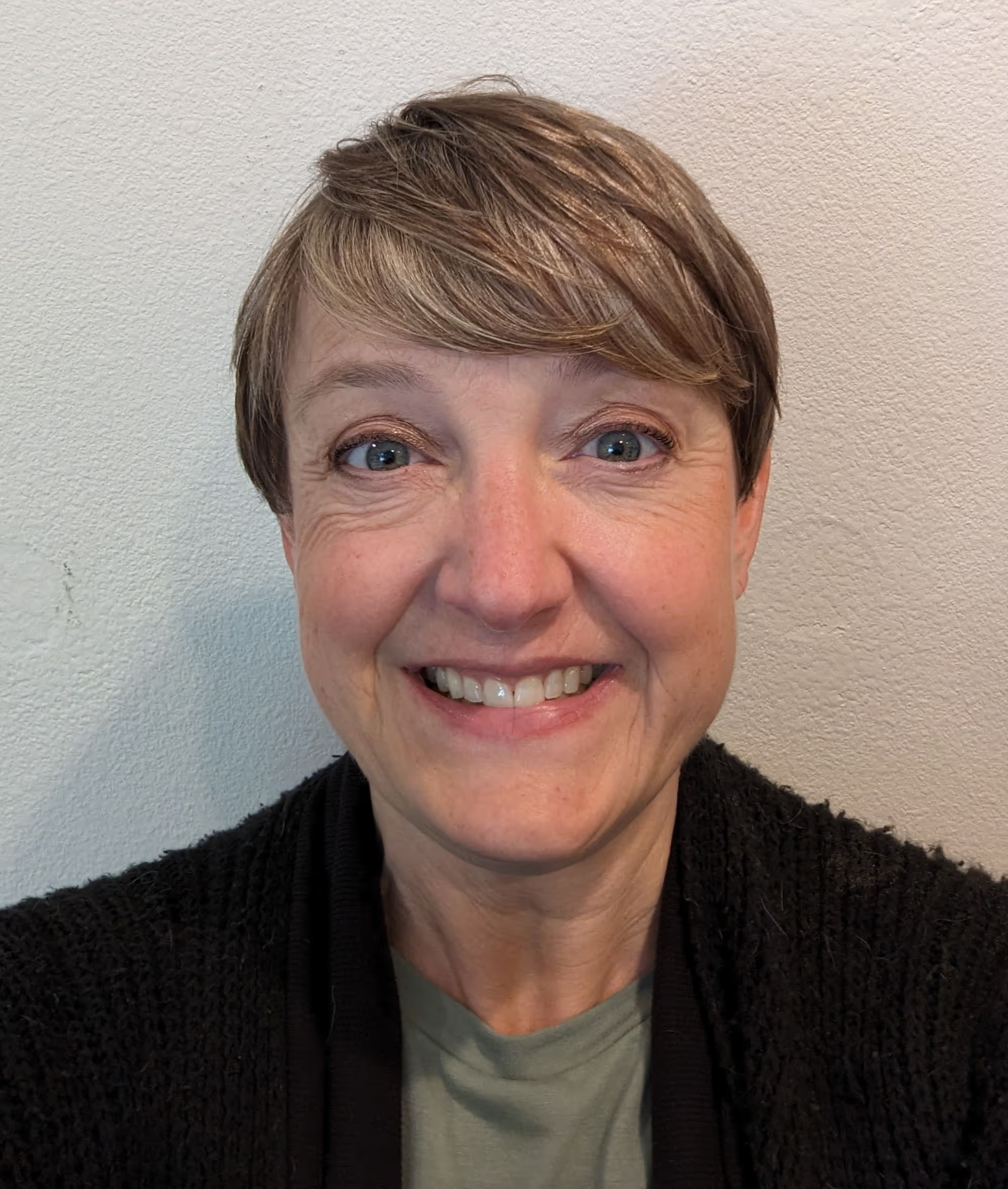
Allison Batty-Capps is a consciousness catalyst, spiritual teacher, and transmitter of Divine Human embodiment. She is a licensed mental health therapist, Reiki Master, Yoga Coach and spiritual channeler. She works at the intersection of psychology, mysticism, shadow alchemy, and God-consciousness, offering teachings that unify the human and the divine.
Her work is not about healing people — it is about awakening them.
Her presence carries a frequency that reminds others of their inherent sovereignty, their inner wisdom, and their direct connection to the Divine.
Through her books, teachings, sessions, and transmissions, Allison guides people into the maturity of spiritual adulthood — where compassion meets boundaries, love meets truth, and the soul meets the body.
She is devoted to helping humanity evolve beyond fear, beyond hierarchy, and beyond old paradigms of spirituality into a new era of embodied consciousness.
Allison lives what she teaches.
Her life reveals what unfolds when a person remembers they are not alone or separate, but a wave formed from the infinite ocean of God’s consciousness.
Join the Community!
Receive wellness tips, resources, book updates, and more directly in your inbox!
Related Posts

I’m Done Confusing Silence With Healing
The Abuse Didn’t End When the Abuse Stopped
