Relationships You Can Love Your Parent and Still Need Something Different

You can love someone deeply and still realize that the way you relate to each other isn’t healthy for either of you.
Sometimes that is one of the most painful realizations we can have.
Because when we love someone, we often assume that love should be enough.
If I love them, shouldn’t we be able to work this out?
If they love me, shouldn’t they understand?
If we both care about each other, why does this relationship still hurt?
These questions can become especially complicated in family relationships.
We may love our parents, siblings, children, or other family members profoundly while simultaneously recognizing that the relationship has patterns that leave us feeling anxious, responsible, resentful, depleted, or disconnected from ourselves.
And this is where an important concept from psychology can help us understand what is happening:
Differentiation.
Differentiation is the process of becoming a separate person while remaining connected to the people we love.
It sounds simple.
But for many of us, particularly those who grew up in emotionally complicated, unpredictable, or highly enmeshed families, learning to become a separate person can be incredibly difficult.
Because sometimes we learned very early that staying connected required us to monitor other people’s emotions.
When connection becomes emotional monitoring
As children, we are dependent on the people around us.
We need caregivers for food, shelter, protection, emotional regulation, and belonging.
So it makes sense that children become highly attuned to the emotional environment around them.
We learn to notice:
- Is Mom upset?
- Is Dad angry?
- Did I do something wrong?
- Is someone withdrawing?
- Should I make myself smaller?
- Should I be helpful?
- Should I apologize?
- Should I try to make everyone feel better?
For some children, this attunement is simply part of being sensitive and perceptive.
For others, it becomes a survival strategy.
For me it was both. I am neurodivergent and I had to learn these skills in order to survive my family.
If the emotional environment is unpredictable, a child may learn that keeping track of other people’s emotions helps maintain a sense of safety.
We become good at reading the room.
We notice subtle changes in tone.
We anticipate reactions.
We adjust ourselves.
We learn what makes someone happy.
We learn what makes someone angry.
We learn what might lead to withdrawal, conflict, criticism, or rejection.
And these adaptations can become incredibly sophisticated.
They can also become incredibly difficult to turn off.
The gifts and costs of hyper-attunement
One of the things I’ve come to understand about my own experience is that some of these adaptations have genuinely served me well.
I’ve become deeply perceptive.
I’ve developed an ability to understand people’s emotional experiences.
I’ve spent years studying trauma, psychology, neuroscience, mindfulness, spirituality, and relationships, and much of that learning has helped me develop an extraordinary amount of compassion for human behavior.
I can often see that when someone lashes out, there may be pain underneath it.
I can recognize that someone’s defensiveness may come from fear.
I can understand that withdrawal may be connected to someone’s history.
I can remember that another person’s behavior isn’t necessarily about me.
These are valuable capacities.
But there is a difference between being connected to another person’s experience and feeling responsible for that experience.
That distinction has become enormously important in my own healing.
Because compassion can become problematic when it requires us to abandon ourselves.
When someone else’s feelings become our responsibility
Imagine saying to your parent:
“I understand that you’re hurt, but I don’t have the capacity to do what you’re asking.”
Or:
“I understand that you experienced my behavior as rejecting, but that wasn’t my intention.”
Or simply:
“I love you, and I can’t do that.”
For someone who learned early that another person’s unhappiness meant something was wrong with them, these statements can feel incredibly threatening.
Someone is disappointed.
Someone is angry.
Someone thinks we’re being selfish.
Someone doesn’t approve of our decision.
Someone says we’ve hurt them.
And suddenly, instead of simply having a conversation, our nervous system may interpret the situation as a threat to the relationship itself.
We may feel compelled to fix it.
We explain.
We apologize.
We reassure.
We over-explain.
We try to prove that we love them.
We try to convince them that we’re still a good daughter, son, sibling, partner, or parent.
We may even abandon our own position simply to restore emotional equilibrium.
This has been the way I have over-functioned in my relationships, which I am learning to shift.
This is where differentiation becomes so important.
“I see you, and I still see me.”
A differentiated adult can hold two realities simultaneously.
I understand that you’re hurt.
And:
I don’t agree that I did something wrong.
I love you.
And:
I cannot meet that need.
I understand that you wanted something different from me.
And:
I was at capacity.
I care about your feelings.
And:
Your feelings are not mine to manage.
This doesn’t mean becoming cold or detached.
It doesn’t mean becoming selfish.
It doesn’t mean refusing to consider how our behavior affects other people.
Quite the opposite.
Differentiation allows us to remain connected while becoming more honest.
We don’t have to agree in order to remain connected.
We don’t have to erase ourselves in order to love someone.
We don’t have to make another person’s emotional reality our own.
We can say:
“I see you, and I still see me.”
That may be one of the most important sentences in relational healing.
Love is not the same as fusion
We sometimes confuse closeness with fusion.
We imagine that if two people really love one another, they should think alike, feel alike, want the same things, and be able to meet each other’s needs naturally.
But healthy intimacy doesn’t require two people to become one person.
Healthy intimacy allows two whole people to remain themselves.
You can love your mother without living according to her expectations.
You can love your father without needing his approval.
You can love your sibling without becoming responsible for their emotional wellbeing.
You can love your adult child without having unlimited access to their life.
You can love your partner without giving up your autonomy.
Love does not require the disappearance of the self.
In fact, genuine intimacy requires a self to be present.
Why boundaries can feel like rejection
This is one reason boundaries can be so difficult in family relationships.
If we learned that connection depended on keeping someone else happy, a boundary can feel like rejection.
Someone may experience our boundary as:
“You don’t love me.”
“You don’t care about me.”
“You’re abandoning me.”
“You’re choosing yourself over the family.”
And we may begin to question ourselves.
Maybe I am being selfish.
Maybe I’m being too rigid.
Maybe I should explain this better.
Maybe if they understood why I need this boundary, they wouldn’t be so upset.
Sometimes this leads us into an exhausting cycle where we repeatedly explain ourselves in an attempt to make the other person’s emotional reaction disappear.
But a boundary doesn’t have to be universally understood in order to be valid.
Another person is allowed to dislike your boundary.
They are allowed to disagree with it.
They are allowed to feel disappointed.
And you are allowed to have the boundary anyway.
That doesn’t mean every boundary is healthy or reasonable.
We still have a responsibility to examine our own behavior and ask whether our boundaries are being used to create healthy separation or to punish, control, or avoid accountability.
But someone else’s disagreement with our boundary does not automatically make the boundary wrong.
Differentiation isn’t about becoming less compassionate
Sometimes people hear messages about boundaries and differentiation and worry that they will become hard, selfish, or disconnected.
I understand that fear.
I don’t want to become someone who responds to hurt by becoming less compassionate.
I don’t want to stop seeing the humanity in other people.
I don’t want to use my own healing as an excuse to stop considering how my behavior affects others.
But I also don’t want to be so compassionate toward another person’s pain that I disappear from the relationship.
That is not sustainable either.
The goal isn’t:
Their needs or my needs.
The goal is:
Their needs and my needs.
Their feelings and my feelings.
Their autonomy and my autonomy.
Their experience and my experience.
Two separate human beings who can care about one another without requiring the other person to become an extension of themselves.
Understanding trauma without using it to erase responsibility
Trauma-informed relationships require an important balance.
We can understand why someone behaves the way they do without saying that their behavior is acceptable.
The same is true for ourselves.
I can understand that some of my own patterns developed for very good reasons.
I can have compassion for the younger version of myself who learned to monitor other people’s emotions.
I can recognize that these patterns helped me navigate difficult circumstances.
And I can still ask:
Does this behavior serve me now?
That question is at the heart of healing.
Because a strategy can be adaptive in childhood and become limiting in adulthood.
The child who learned to keep everyone happy may become an adult who struggles to identify what she actually wants.
The child who learned to avoid conflict may become an adult who has difficulty expressing disagreement.
The child who learned to monitor everyone’s emotions may become an adult who feels responsible for regulating everyone around her.
The child who learned that love required accommodation may become an adult who confuses self-abandonment with compassion.
Healing doesn’t mean blaming the child for developing these strategies.
It means giving the adult permission to develop new ones.
Differentiation asks a difficult question
One of the most challenging questions in family healing is:
Can I remain connected to you without abandoning myself?
Sometimes the answer is yes.
Sometimes it requires new boundaries.
Sometimes it requires difficult conversations.
Sometimes it requires family therapy.
Sometimes it requires changing the way we communicate.
Sometimes it requires accepting that the relationship may need more distance.
And sometimes it means recognizing that we cannot create a healthy relationship with someone who is unwilling or unable to participate in creating one.
That last possibility can be especially painful.
Because love doesn’t disappear simply because a relationship becomes unhealthy.
You can love someone and still recognize that you cannot continue relating to them in the same way.
When love isn’t enough
This is why I chose the title When Love Isn’t Enough for this series.
Not because love isn’t important.
Love is profoundly important.
But love by itself does not automatically create healthy relationships.
Healthy relationships also require:
Respect.
Boundaries.
Mutuality.
Accountability.
Emotional safety.
Autonomy.
A willingness to listen.
A willingness to repair.
Room for differences.
And a recognition that both people are separate human beings with their own internal worlds.
You can love someone and still not be able to have a healthy relationship with them under the current conditions.
That doesn’t make the love fake.
It means love and relationship are not exactly the same thing.
Finding yourself inside the relationship
For me, differentiation isn’t about becoming less connected.
It’s about becoming more fully myself while remaining capable of connection.
It’s learning to know what I feel.
What I need.
What I want.
What I believe.
What I can offer.
What I cannot offer.
What belongs to me.
And what doesn’t.
It’s learning that someone else’s disappointment doesn’t necessarily mean I’ve done something wrong.
It’s learning that someone else’s anger doesn’t automatically require me to fix the situation.
It’s learning that I can listen to someone else’s experience without surrendering my own.
And perhaps most importantly, it’s learning that being a loving person does not require me to be endlessly available.
“I love you, and I can’t do that.”
There is a profound freedom in being able to say:
I love you, and I can’t do that.
I understand you’re disappointed, and my answer is still no.
I hear that you experienced it differently, and my experience is still real.
I care about you, and I need some distance right now.
I understand your pain, and I am not able to take responsibility for making it go away.
These aren’t necessarily statements of rejection.
They can be statements of differentiation.
They say:
“You are you.”
“I am me.”
“And I want to discover whether we can have a relationship where both of us are allowed to exist.”
Perhaps healing isn’t about loving less
Maybe the goal of differentiation isn’t to love less.
Maybe it’s to love without disappearing.
To remain compassionate without becoming responsible for everyone else’s emotions.
To remain connected without becoming fused.
To have boundaries without turning them into weapons.
To hear another person’s truth without surrendering your own.
To take responsibility for your part without taking responsibility for everything.
And perhaps, ultimately, to become able to say:
“I see you, and I still see me.”
That is the kind of relationship I’m learning to create.
And it is the kind of relationship I believe we all deserve.
If you’re learning to find yourself inside your relationships
If you’re navigating difficult family relationships, setting boundaries, healing from childhood patterns, or trying to understand how to remain connected without abandoning yourself, this work can be deeply transformative.
My own journey has taught me that healing isn’t about becoming perfectly independent or perfectly connected.
It’s about learning how to hold both.
I offer wellness coaching, energy healing, and spiritual mentorship for people who want to explore their emotional patterns, relationships, boundaries, spirituality, and deeper healing in a compassionate and grounded way.
You can learn more about working with me at blossomingheartwellness.com.
You can also explore these themes more deeply in my book, The Divine Within: Healing Ourselves to Heal the World, which explores the intersection of spirituality, psychology, neuroscience, and our capacity for healing and transformation.
Perhaps the question isn’t:
“How do I keep everyone happy enough that the relationship survives?”
Perhaps the deeper question is:
“How do I stay connected to love without leaving myself behind?”
About The Author
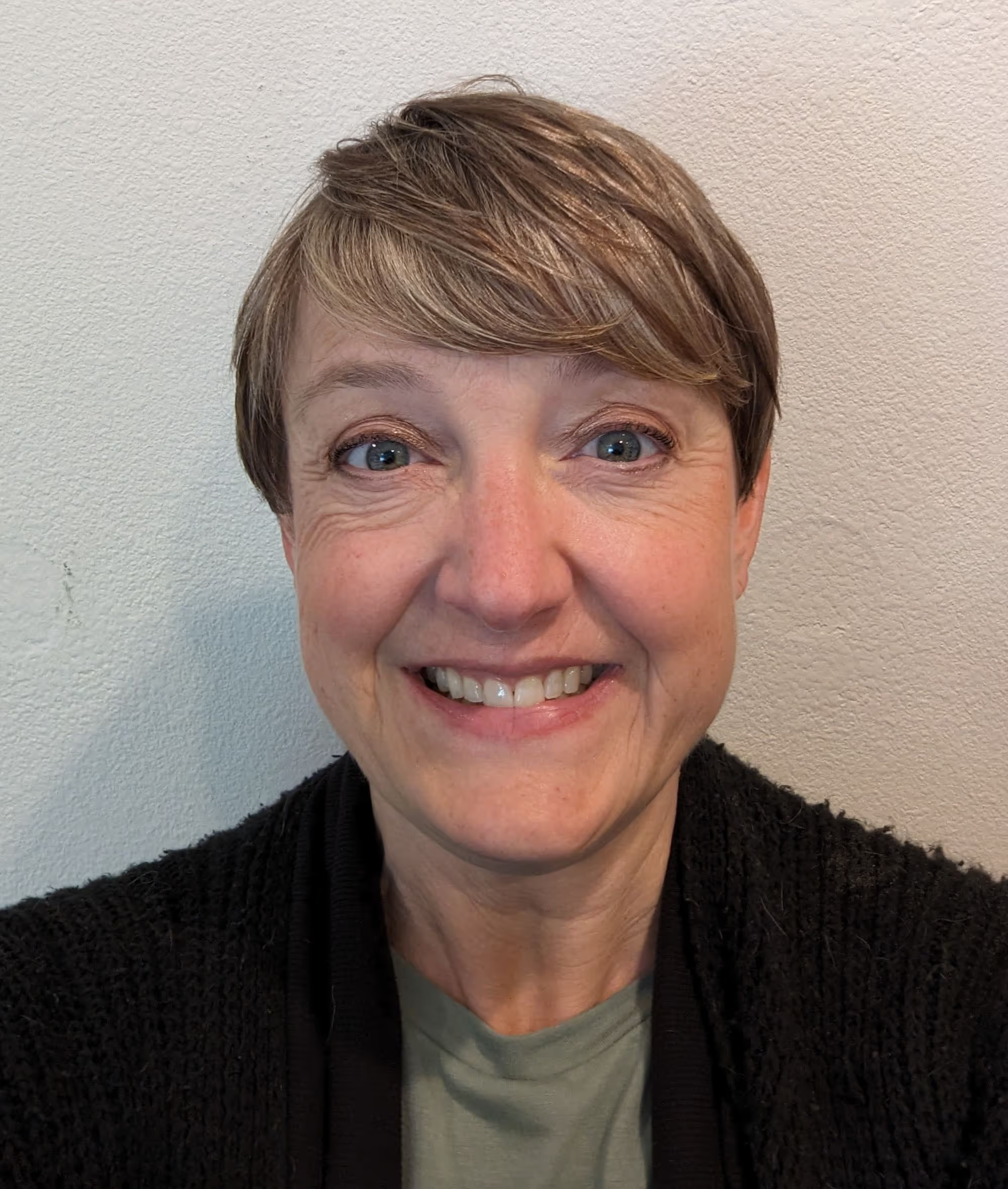
Allison Batty-Capps is a consciousness catalyst, spiritual teacher, and transmitter of Divine Human embodiment. She is a licensed mental health therapist, Reiki Master, Yoga Coach and spiritual channeler. She works at the intersection of psychology, mysticism, shadow alchemy, and God-consciousness, offering teachings that unify the human and the divine.
Her work is not about healing people — it is about awakening them.
Her presence carries a frequency that reminds others of their inherent sovereignty, their inner wisdom, and their direct connection to the Divine.
Through her books, teachings, sessions, and transmissions, Allison guides people into the maturity of spiritual adulthood — where compassion meets boundaries, love meets truth, and the soul meets the body.
She is devoted to helping humanity evolve beyond fear, beyond hierarchy, and beyond old paradigms of spirituality into a new era of embodied consciousness.
Allison lives what she teaches.
Her life reveals what unfolds when a person remembers they are not alone or separate, but a wave formed from the infinite ocean of God’s consciousness.
Join the Community!
Receive wellness tips, resources, book updates, and more directly in your inbox!
Related Posts
Rupture and Repair
When the World Reopens Old Wounds
.jpg)