The Abuse Didn’t End When the Abuse Stopped
The abuse didn't end when the abuse stopped.
That is something I have carried for most of my life.
I don't talk publicly very often about the fact that I was sexually abused throughout my childhood and sexually assaulted several times in adulthood. But I have come to understand that there is something important about acknowledging not only what happened, but also what happens after the abuse ends.
Because childhood trauma doesn't simply become a memory.
For many survivors, the effects of sexual abuse can become woven into the way the brain and nervous system learn to experience the world.
And sometimes, the journey of healing begins long after the person who caused the harm is no longer present.
For me, one of the most profound manifestations of this has been sleep.
My childhood abuse happened while I was sleeping.
And that matters in ways that are difficult to explain unless you've experienced something similar.
Sleep is supposed to be a time when we surrender control.
We become vulnerable.
We stop monitoring our environment.
Our bodies rest and repair.
Our conscious minds become less vigilant.
But what happens when a developing nervous system learns that even while you're asleep, your body isn't necessarily safe?
For me, the answer has sometimes been that sleep itself can feel dangerous.
Even decades later.
When your body learns that it cannot let its guard down
I can understand intellectually that I am an adult.
I can understand that I am safe now.
I can understand that what happened to me happened in the past.
But the nervous system doesn't always operate according to intellectual understanding.
Sometimes I still wake up screaming or crying.
Sometimes there is a part of my nervous system that seems unwilling to completely surrender consciousness during sleep.
It's as though some ancient protective system is still saying:
Don't let your guard down.
And when I think about that through the lens of trauma and neuroscience, I have enormous compassion for the system that learned that lesson.
Because it wasn't irrational.
It was responding to the environment it was given.
A child's brain develops in relationship to the environment
One of the things neuroscience has helped me understand is that the brain and nervous system develop in interaction with our experiences.
During childhood, systems involved in threat detection, emotional regulation, memory, attachment, and executive functioning are still developing.
The developing brain is constantly learning:
What is the world like?
Are other people safe?
Can I relax?
What happens when I need something?
What happens when I say no?
Will someone protect me?
Can I trust my environment?
When a child grows up in a safe and responsive environment, those experiences provide opportunities for the nervous system to develop ways of regulating threat, emotion, connection, and rest.
But when a child experiences chronic fear, unpredictability, abuse, or attachment disruption, the brain has to adapt to that environment.
It becomes important to detect danger.
To anticipate.
To monitor.
To protect.
To respond quickly.
These adaptations can be incredibly intelligent.
They can also become exhausting when the original danger is gone.
The adaptations can look like personality
One of the most difficult things about trauma is that protective adaptations can eventually become so deeply integrated into our lives that we stop recognizing them as adaptations.
We may simply think:
This is who I am.
Maybe I'm just anxious.
Maybe I'm too sensitive.
Maybe I'm controlling.
Maybe I'm intense.
Maybe I think too much.
Maybe I can't let things go.
Maybe I'm too emotional.
Maybe I care too much about other people.
Maybe I need too much reassurance.
Maybe I'm incapable of relaxing.
But sometimes there is another question we can ask:
What if this part of me developed for a reason?
That question has changed the way I understand myself.
What is this part of me trying to protect?
I've become extremely aware of unhealthy patterns in relationships and communication.
I notice subtle changes in people's emotional states.
I can often recognize when someone is becoming activated.
I'm highly sensitive to injustice.
I'm good at analyzing systems and asking what could change to reduce harm.
I pursue connection intensely when I'm afraid of losing it.
When a relationship feels uncertain or threatened, I can become intensely focused on understanding what is happening and trying to repair it.
For a long time, I might have looked at these things and asked:
What's wrong with me?
Now I can ask a different question:
What is this part of me trying to protect?
And the answers are surprisingly loving.
My hypervigilance is trying to keep me safe.
My intensity is trying to preserve connection.
My need to understand is trying to make an unpredictable world make sense.
My sensitivity is trying to notice danger before it happens.
My ability to read other people is trying to anticipate what might happen next.
When I see those parts of myself this way, I don't have to hate them.
I can appreciate what they were trying to do.
The problem isn't that these capacities exist
This distinction has been enormously important in my healing.
I don't want to get rid of my sensitivity.
I don't want to become less perceptive.
I don't want to stop caring deeply about other people.
I don't want to lose my curiosity.
I don't want to become less passionate about justice.
I don't want to stop valuing connection.
These qualities are part of what I love about myself.
The problem isn't necessarily that these capacities exist.
The problem is that my nervous system sometimes learned to deploy them in situations where they are no longer necessary.
Hypervigilance can become exhausting.
Empathy can become over-responsibility.
Curiosity can become obsessive analysis.
Desire for connection can become relational pursuit.
Protectiveness can become difficulty relaxing.
The work isn't necessarily to destroy these qualities.
It is to help them become more flexible.
Healing doesn't mean getting rid of our protectors
This is one of the reasons I have become increasingly interested in approaches to healing that don't treat traumatized parts of ourselves as enemies.
I don't want to wage war against my own nervous system.
I don't want to tell myself:
"Stop being hypervigilant."
"Stop being so sensitive."
"Stop needing connection."
"Stop thinking about it."
"Just let it go."
Those instructions don't necessarily create safety.
Sometimes they create another layer of shame.
Instead, I want to be able to turn toward these parts of myself and say:
I understand why you're here.
I understand what you're trying to do.
Thank you for protecting me.
You don't have to work quite so hard anymore.
That is a very different relationship with ourselves.
The intersection of psychology, neuroscience, and spirituality
This is where the different parts of my work come together for me.
Psychology can help us understand trauma, attachment, protective patterns, and the ways our relationships shape our emotional lives.
Neuroscience can help us understand how experiences influence the developing nervous system and why patterns can persist long after the original danger has passed.
And spirituality can offer another dimension:
Can I relate to myself with compassion rather than shame?
Can I recognize the humanity of the parts of myself that I have spent years trying to eliminate?
Can I see the frightened parts of myself not as broken, but as parts that were trying desperately to protect something precious?
For me, that has been transformative.
Even my shadow can see my light
I sometimes think of these protective parts as my shadow.
Not because they are evil.
Not because they are something I need to eradicate.
But because they contain experiences and qualities that I may have learned to reject or hide.
And I've come to believe something I find deeply beautiful:
Even my shadow can see my light.
My protective parts know that there is something precious inside me worth protecting.
They were trying to keep me alive.
They were trying to keep me connected.
They were trying to keep me safe.
They were trying to help me make sense of a world that sometimes didn't make sense.
That doesn't mean every strategy they developed is still helpful.
But it means I can appreciate the intention underneath the strategy.
Survivors deserve acknowledgement, not just instructions to move on
There is another part of trauma healing that I think deserves more attention.
Survivors are often encouraged to focus on moving forward.
Regulate yourself.
Forgive.
Heal.
Let go.
Don't live in the past.
And there is certainly value in learning how to build a life beyond trauma.
But sometimes the emphasis on moving forward leaves something essential behind:
Acknowledgement.
Something happened.
It mattered.
It changed you.
And you should not have had to experience it.
For survivors of sexual violence, there is also the painful reality that perpetrators are often never held meaningfully accountable.
The legal system does not always provide the justice survivors hope for.
And even when a survivor is believed, accountability may not look anything like what they imagined.
That can create another wound.
The survivor is left carrying the consequences while the person who caused the harm may never experience anything comparable to the impact they created.
This is one reason I believe we need to be careful about framing healing solely as an individual's responsibility.
Healing is not simply:
"How can you regulate yourself better?"
We also need to be willing to ask:
What happened to you?
Who was responsible?
What did you need that you didn't receive?
What would justice, acknowledgement, and support look like?
The burden of healing should never become another way of placing responsibility on the survivor for what happened to them.
Sexual violence can affect our relationship with our bodies
Sexual abuse is not only something that happens psychologically.
Something happens to the body.
Something happens to our sense of safety.
Something can happen to our ability to trust.
And for some survivors, something happens to the fundamental experience of being at home inside the body.
This has been part of my journey.
Learning that my body is not where the danger lives anymore.
Learning that I can inhabit it.
Learning that I can listen to it.
Learning that I can rest.
Learning that I can sleep.
Learning that I don't have to monitor everything and everyone.
And I am still learning.
I am not telling this story as someone who has conquered trauma
After more than two decades of trauma therapy and experiences with approaches including EMDR, brainspotting, meditation, yoga, energy healing, and extensive study of psychology, neuroscience, spirituality, and trauma, I still experience effects of what happened to me.
I don't say that to suggest that healing isn't possible.
Quite the opposite.
I say it because I think we need a more nuanced understanding of what healing can mean.
I don't believe healing necessarily means becoming the person you would have been if the trauma had never happened.
I don't know who that person would have been.
Instead, perhaps healing means becoming more fully the person you are now while understanding why you became the way you became.
It means learning to love the child who survived.
It means appreciating the protectors who carried you.
It means learning new ways to respond when those protectors become activated.
It means allowing yourself to have compassion for the adaptations that once kept you safe.
And it means slowly teaching your nervous system that the present is not the past.
You don't have to reject your shadow to live in your light
For me, healing has increasingly become an invitation to turn toward the parts of myself I once wanted to fix.
To say:
I see why you became this way.
I understand that you were trying to protect me.
I love you.
And you are safe enough to rest now.
That last sentence is particularly meaningful to me.
Because perhaps the deepest healing isn't finally getting rid of the parts of ourselves shaped by trauma.
Maybe it is developing enough safety, compassion, and awareness that those parts no longer have to work so hard.
Maybe healing is not becoming less of ourselves.
Maybe it is becoming more fully ourselves.
Coming home to all of ourselves.
Including the frightened parts.
The angry parts.
The hypervigilant parts.
The intensely loving parts.
The parts that still don't understand why something happened.
The parts that are still learning how to trust.
The parts that have carried us farther than we realized.
If you're still carrying what happened
If you are a survivor, I want you to know something simple:
You are not weak because your body still remembers.
You are not broken because something that happened years ago still affects you.
You are not failing because healing isn't linear.
And you don't have to hate the parts of yourself that developed to survive.
Those parts may have been doing exactly what they needed to do at the time.
Healing can be learning, slowly and compassionately, that the environment has changed.
That you have more choices now.
That you can develop new ways of protecting yourself.
That rest can become safer.
That connection can become safer.
That your body can become a home again.
And perhaps, eventually, that the part of you that has been standing guard for so long can hear:
You don't have to work so hard anymore.
I'm here now.
I've got you.
You are safe enough to rest.
If you want to explore this work more deeply
My work brings together psychology, neuroscience, spirituality, trauma-informed healing, and lived experience.
I believe healing doesn't require us to reject the parts of ourselves that needed to survive. Instead, we can learn to understand those parts with compassion while developing new ways of living, relating, and responding.
My book, The Divine Within: Healing Ourselves to Heal the World, explores many of these themes—the relationship between our inner worlds, healing, spirituality, psychology, and our capacity to transform the way we relate to ourselves and others.
You can learn more about the book and my work at blossomingheartwellness.com.
And if you are a survivor reading this, I hope you remember:
What happened to you was not your fault.
Your adaptations make sense.
You are more than what happened to you.
And you don't have to become someone who never hurts, never struggles, or never remembers.
You can become someone who understands.
Someone who has compassion for the parts of yourself that survived.
Someone who learns, little by little, that the danger is no longer happening now.
Someone who can finally begin to come home to yourself.
With deep love,
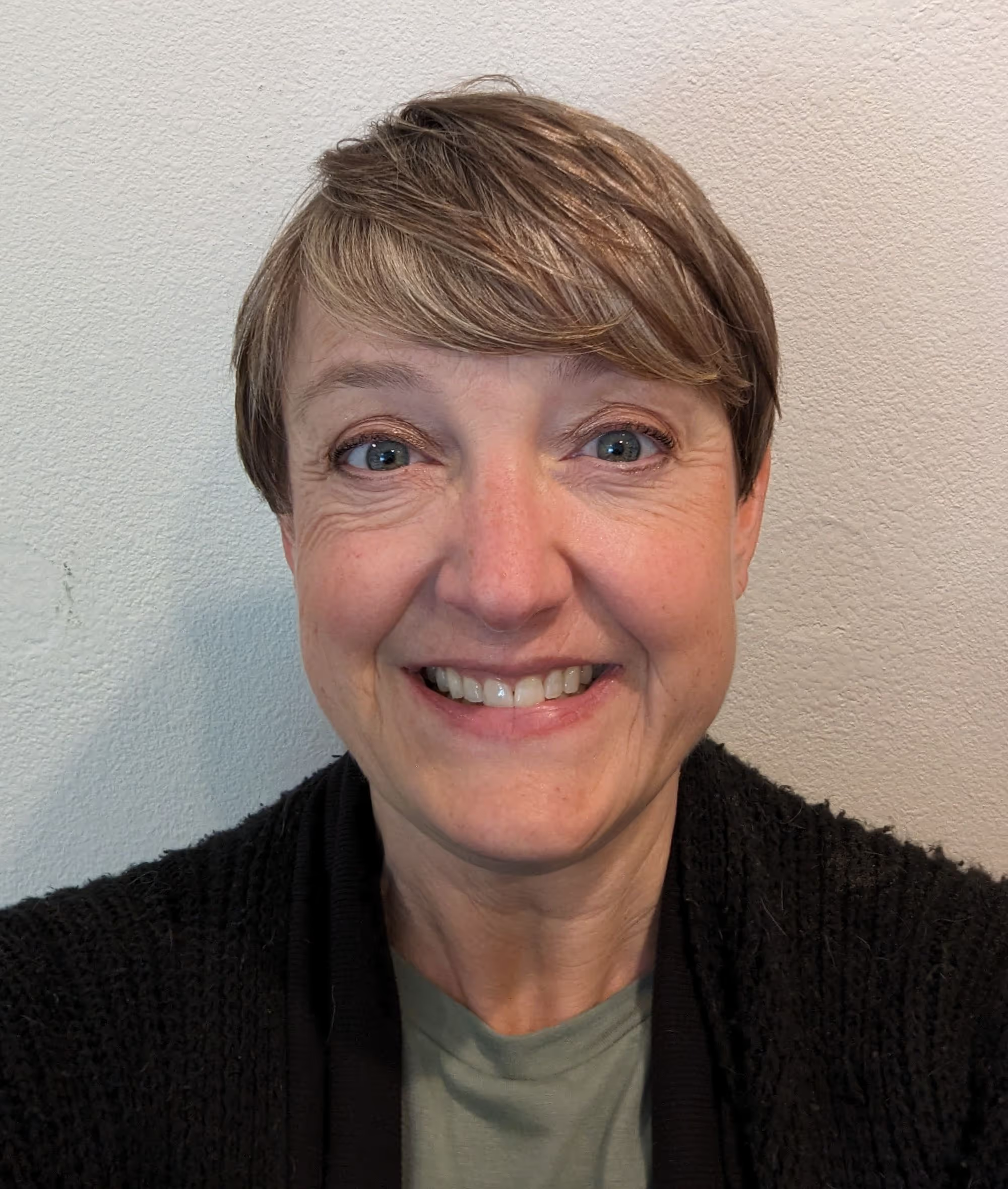
Allison Batty-Capps
About The Author
Allison Batty-Capps is a consciousness catalyst, spiritual teacher, and transmitter of Divine Human embodiment. She is a licensed mental health therapist, Reiki Master, Yoga Coach and spiritual channeler. She works at the intersection of psychology, mysticism, shadow alchemy, and God-consciousness, offering teachings that unify the human and the divine.
Her work is not about healing people — it is about awakening them.
Her presence carries a frequency that reminds others of their inherent sovereignty, their inner wisdom, and their direct connection to the Divine.
Through her books, teachings, sessions, and transmissions, Allison guides people into the maturity of spiritual adulthood — where compassion meets boundaries, love meets truth, and the soul meets the body.
She is devoted to helping humanity evolve beyond fear, beyond hierarchy, and beyond old paradigms of spirituality into a new era of embodied consciousness.
Allison lives what she teaches.
Her life reveals what unfolds when a person remembers they are not alone or separate, but a wave formed from the infinite ocean of God’s consciousness.
Join the Community!
Receive wellness tips, resources, book updates, and more directly in your inbox!
Related Posts

Relationships You Can Love Your Parent and Still Need Something Different
Rupture and Repair