What Happens After Spiritual Awakening?
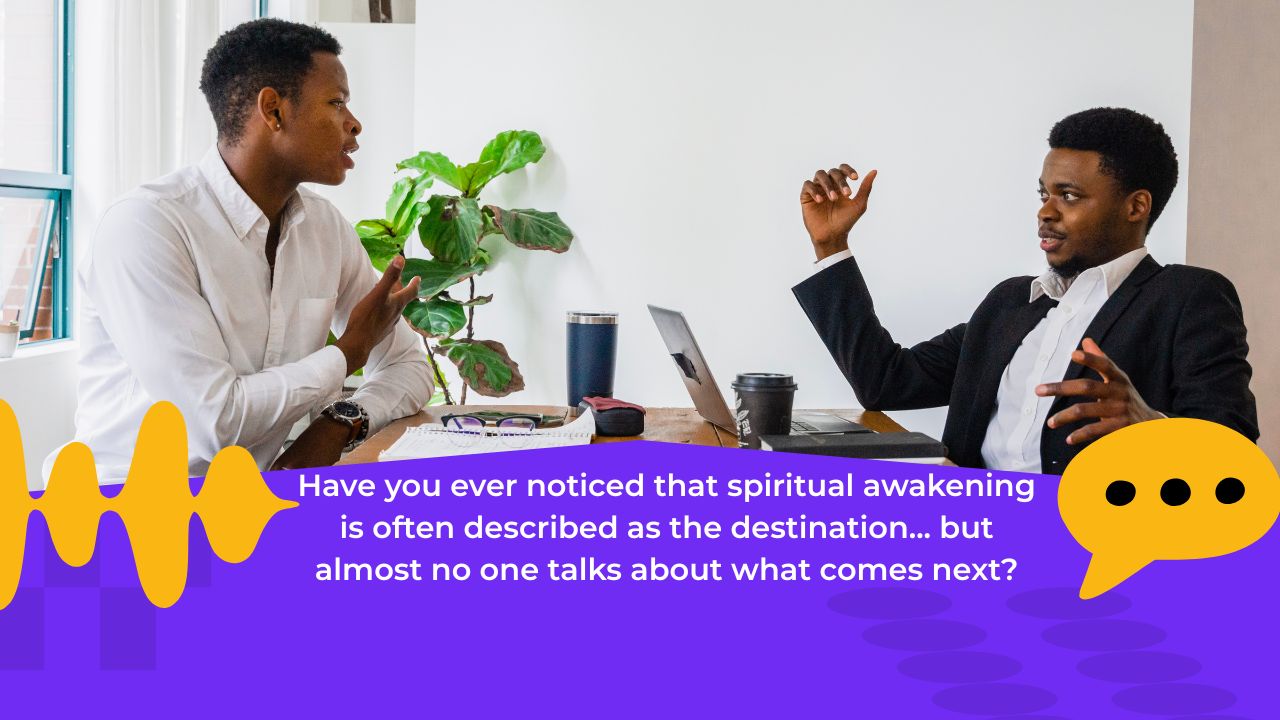
Spiritual awakening is often described as a destination.
We hear about enlightenment, raising our vibration, remembering who we truly are, transcending the ego, or expanding consciousness.
There are countless books, retreats, podcasts, and videos devoted to helping us awaken.
But I've noticed something curious over the past twenty-five years of studying spirituality, psychology, neuroscience, trauma healing, meditation, and contemplative traditions:
Very few people talk about what comes next.
What happens after the retreat ends?
After the mystical experience fades?
After the meditation cushion is put away?
How do we actually live as human beings after awakening?
Not during the moments that feel extraordinary.
I mean on an ordinary Tuesday morning.
When you're grieving.
When your marriage is struggling.
When your nervous system is overwhelmed.
When your business isn't growing.
When you're caring for aging parents.
When you receive difficult medical news.
When you still feel anxious before a difficult conversation.
When the world feels heartbreaking.
These are the questions that have become far more interesting to me than the question of awakening itself.
Because I no longer think awakening is the finish line.
I think it may be the beginning.
My Own Assumptions About Awakening
There was a season in my life when I quietly believed that if I healed enough, understood enough, or became spiritually mature enough, life would finally stop feeling so difficult.
Perhaps you've had similar thoughts.
"If I meditate enough..."
"If I release enough trauma..."
"If I become more conscious..."
"If I surrender more completely..."
"...then I won't struggle anymore."
I never consciously chose those beliefs.
They simply emerged from the ways spirituality is often described.
Awakening was presented almost like an arrival point—a place where suffering disappears and peace becomes permanent.
But my own experience has been very different.
I still experience grief.
I still feel uncertainty.
I still wrestle with difficult questions.
I still have moments when injustice breaks my heart.
I still have days when I question myself.
The difference isn't that I'm no longer human.
The difference is that my relationship with being human has changed.
That, for me, has been the real transformation.
Awakening Didn't Remove My Humanity
One of the greatest surprises of my own healing journey has been realizing that spirituality did not remove my humanity.
It deepened my capacity to inhabit it.
Instead of trying to avoid difficult emotions, I became more curious about them.
Instead of judging fear, I began asking what it was trying to protect.
Instead of believing grief meant something was wrong, I began seeing grief as evidence that something precious had been loved.
Instead of trying to become someone who never struggled, I slowly began learning how to struggle with greater compassion.
That shift changed everything.
Because perhaps the goal of awakening is not to eliminate our humanity.
Perhaps it is to transform our relationship with it.
Psychology Has Something Important to Teach Spirituality
As both a therapist and a spiritual mentor, I have become increasingly convinced that psychology and spirituality are not opposing paths.
They illuminate different aspects of the same human experience.
Spirituality reminds us that we are more than our wounds.
Psychology reminds us that we cannot heal by pretending those wounds do not exist.
Spirituality points us toward transcendence.
Psychology helps us understand embodiment.
Spirituality invites us to remember our deeper nature.
Psychology teaches us how our nervous systems, attachment histories, relationships, and life experiences shape the way we experience that deeper nature.
Neither perspective feels complete to me on its own.
Together, they create a richer understanding of what it means to heal.
Your Nervous System Doesn't Stop Existing Because You Awaken
One of the greatest gifts neuroscience has offered spiritual communities is this reminder:
Your nervous system still matters.
You may have profound mystical experiences.
You may experience deep states of peace.
You may genuinely feel connected to something greater than yourself.
And...
Your nervous system still responds to stress.
Your body still carries memory.
Your attachment patterns may still become activated in close relationships.
Healing is rarely about erasing these realities.
It is about developing greater awareness and flexibility within them.
A healthy nervous system does not stop experiencing fear.
It learns to recognize fear without becoming completely controlled by it.
Likewise, awakening does not eliminate our humanity.
It changes how we relate to it.
Ordinary Life Is Where Awakening Is Tested
It is easy to feel connected during meditation.
It is much harder to remain connected during conflict.
It is easy to feel peaceful on retreat.
It is much harder to stay compassionate when someone misunderstands you.
It is easy to experience unity in moments of transcendence.
It is much harder to embody that awareness while parenting, paying bills, navigating disappointment, or caring for someone who is suffering.
Perhaps ordinary life is not a distraction from awakening.
Perhaps it is where awakening becomes visible.
Not in extraordinary experiences.
But in ordinary moments.
How we listen.
How we repair.
How we respond when we are emotionally activated.
How we treat people who disagree with us.
How we care for ourselves when we are hurting.
These moments reveal far more about our integration than our mystical experiences ever could.
Awakening Is Becoming More Fully Human
One belief has become increasingly central to my work:
I don't think awakening asks us to become less human.
I think it invites us to become more fully human.
More honest.
More compassionate.
More present.
More willing to question our own certainty.
More capable of staying connected during discomfort.
More willing to see both beauty and suffering without needing to deny either.
This kind of awakening feels quieter than many spiritual ideals.
But it also feels more sustainable.
Integration May Be the Real Spiritual Practice
Perhaps the spiritual practices we most need are not only meditation, prayer, or contemplation.
Perhaps they also include:
Listening without immediately defending ourselves.
Apologizing when we cause harm.
Allowing grief to move through us.
Learning to regulate our nervous systems.
Repairing relationships.
Setting healthy boundaries.
Practicing compassion toward ourselves.
Remaining curious when our beliefs are challenged.
Returning to presence after becoming emotionally activated.
These may not look as dramatic as mystical experiences.
But they are profoundly transformative.
Because they allow spirituality to become lived rather than simply believed.
Returning Home to Ourselves
Over time, my understanding of awakening has shifted.
It no longer feels like climbing upward.
It feels like coming home.
Coming home to my body.
Coming home to my relationships.
Coming home to my emotions.
Coming home to my values.
Coming home to the ordinary sacredness of everyday life.
Perhaps awakening is less about becoming extraordinary.
Perhaps it is about becoming fully present for the ordinary miracle of being alive.
Questions Worth Sitting With
Rather than offering answers, I'd like to leave you with a few questions that continue to shape my own journey:
- What has changed in your life since your spiritual awakening?
- What has remained surprisingly human?
- How has your relationship with grief, fear, or uncertainty evolved?
- What does "integration" mean to you?
- What practices help you bring awareness into ordinary life?
- How might psychology and spirituality complement one another in your own healing?
There are no perfect answers.
Only invitations.
The Journey Continues
The more I learn, the less interested I become in appearing spiritually awakened.
The more interested I become in living with integrity.
With compassion.
With humility.
With curiosity.
With a nervous system that continues healing.
With a heart that remains open.
For me, awakening is no longer about escaping the human experience.
It is about learning how to inhabit it with greater love.
And perhaps that is the part of spirituality we need to talk about more often.
Not simply how to awaken—
but how to live after awakening.
Because that is where the real work—and perhaps the deepest beauty—begins.
Continue the Conversation
If these reflections resonate with you, I invite you to explore my book, The Divine Within: Healing Ourselves to Heal the World, where I bring together psychology, neuroscience, spirituality, and trauma-informed healing to explore what it means to become more fully ourselves.
If you're looking for support on your own journey of integrating spiritual awakening with everyday life, I also offer therapy, spiritual mentorship, and wellness coaching through Blossoming Heart Wellness.
My hope is not to offer one "right" path.
It is to create a space where we can explore these questions together—with curiosity, humility, compassion, and a deep respect for the many ways people heal and grow.
About The Author
Allison Batty-Capps is a consciousness catalyst, spiritual teacher, and transmitter of Divine Human embodiment. She is a licensed mental health therapist, Reiki Master, Yoga Coach and spiritual channeler. She works at the intersection of psychology, mysticism, shadow alchemy, and God-consciousness, offering teachings that unify the human and the divine.
Her work is not about healing people — it is about awakening them.
Her presence carries a frequency that reminds others of their inherent sovereignty, their inner wisdom, and their direct connection to the Divine.
Through her books, teachings, sessions, and transmissions, Allison guides people into the maturity of spiritual adulthood — where compassion meets boundaries, love meets truth, and the soul meets the body.
She is devoted to helping humanity evolve beyond fear, beyond hierarchy, and beyond old paradigms of spirituality into a new era of embodied consciousness.
Allison lives what she teaches.
Her life reveals what unfolds when a person remembers they are not alone or separate, but a wave formed from the infinite ocean of God’s consciousness.

Join the Community!
Receive wellness tips, resources, book updates, and more directly in your inbox!
Related Posts
.png)
What If Our Political Divisions Reflect Our Unhealed Relationship Patterns?
When the Body Remembers
.png)