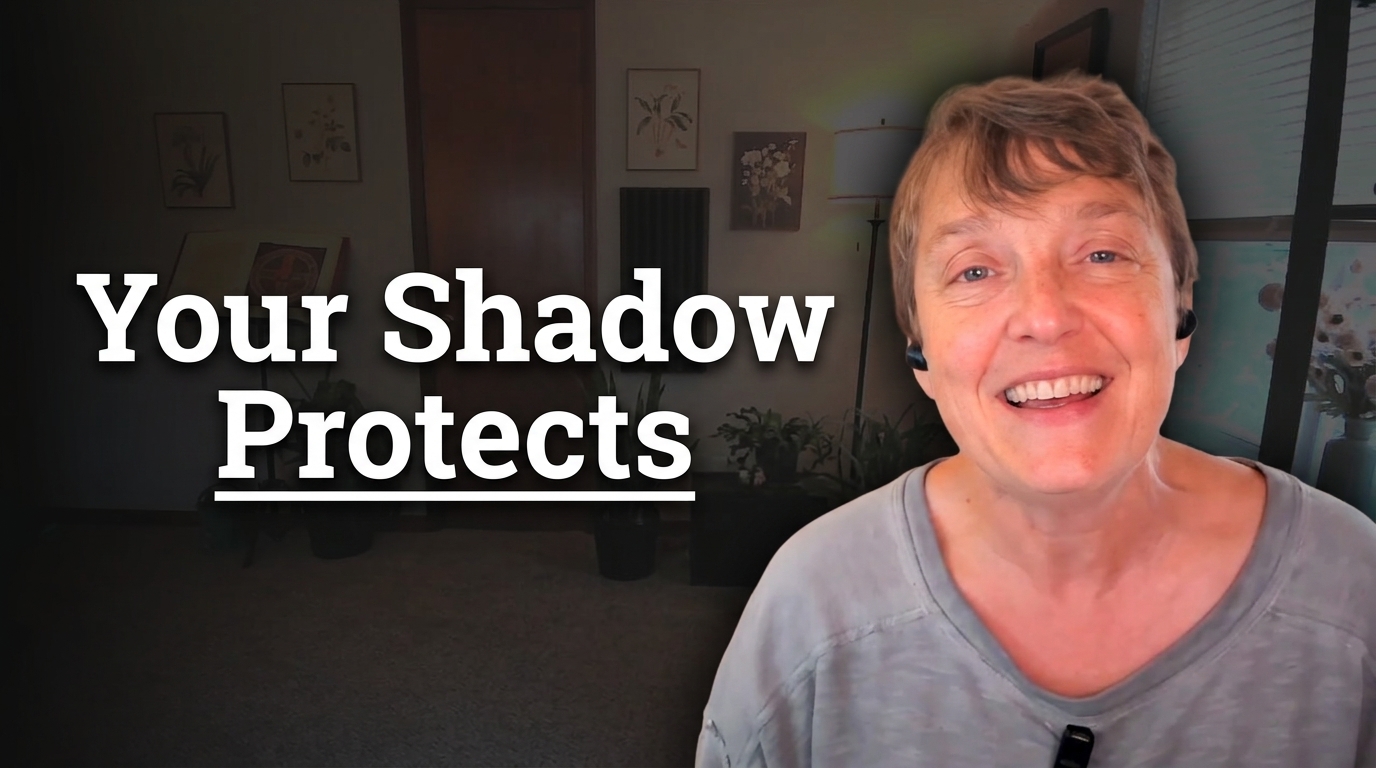
Your Shadow May Be Protecting Your Light
Have you ever had a part of yourself that you really didn't like?
Maybe you overthink everything.
Maybe you become anxious when someone seems distant.
Maybe you try to control situations when you feel uncertain.
Maybe you shut down completely.
Maybe you people-please.
Maybe you pursue connection intensely when you're afraid of losing it.
Or perhaps there are parts of you that you have spent years trying to overcome—parts you have judged as needy, difficult, too sensitive, too emotional, too controlling, too intense, or simply too much.
I've spent a lot of my life trying to understand these parts of myself.
And one of the things I love most about where I am in my healing now is that I don't want to get rid of them anymore.
I want to understand them.
I want to listen to them.
I want to love them.
Because I've come to see that what we call our "shadow" isn't necessarily the opposite of our light.
Sometimes our shadow is the way our light learned to protect itself.
What if your shadow isn't your enemy?
The word shadow can sound ominous.
In psychology, particularly in Jungian psychology, the shadow can refer to aspects of ourselves that we have pushed outside of our conscious identity—qualities, emotions, impulses, needs, or experiences that we have learned are unacceptable or unsafe to express.
But I don't think we have to approach our shadow as something bad that needs to be defeated.
What if we approached it with curiosity instead?
Instead of asking:
"How do I get rid of this part of myself?"
we might ask:
"What is this part trying to protect?"
That question can change everything.
Because sometimes the behavior we don't like is sitting on top of something incredibly human.
Underneath hypervigilance may be awareness.
Underneath intensity may be a profound desire for connection.
Underneath the need to understand may be curiosity.
Underneath people-pleasing may be a longing for belonging.
Underneath control may be a nervous system searching for safety.
Underneath fear of losing someone may be immense love.
The behavior may no longer be serving us.
But that doesn't mean the part of us that developed it is bad.
Our patterns often make sense when we understand where they came from
One of the most compassionate things psychology has taught me is that human beings adapt.
We develop strategies in response to the environments we live in.
If connection has felt unpredictable, we may become exceptionally attentive to changes in another person's mood.
If conflict has felt dangerous, we may become very good at preventing it.
If we learned that other people's emotions determined whether we were safe, we may become highly skilled at reading facial expressions, body language, tone of voice, and subtle shifts in behavior.
If we experienced rejection, abandonment, unpredictability, or relational instability, we may become particularly sensitive to signs that someone is pulling away.
These adaptations can become deeply ingrained.
And some of them may even become strengths.
The person who learned to read a room may eventually become highly empathic.
The person who learned to notice subtle relational shifts may become an excellent therapist, teacher, mediator, parent, friend, or caregiver.
The person who learned to analyze everything may become thoughtful, perceptive, and intellectually curious.
The problem isn't necessarily the capacity itself.
Sometimes the problem is that the nervous system doesn't know when the strategy is no longer necessary.
The nervous system doesn't always know that the past is over
Our brains are constantly making predictions.
Based on previous experiences, the nervous system learns what to pay attention to and what might signal danger.
That means a response that developed in one environment can continue showing up in another—even when the circumstances have changed.
A pause in someone's response can feel like rejection.
A change in someone's tone can feel like danger.
A disagreement can feel like the beginning of abandonment.
Someone needing space can feel like the relationship is ending.
And suddenly the nervous system says:
Pay attention. Figure it out. Fix it. Don't lose the connection.
The conscious mind may know that everything is probably okay.
But the body may not have received that message yet.
This is one reason I think it is so important to move away from shame when we are working with our patterns.
Shame says:
"What's wrong with me?"
Curiosity asks:
"What is happening inside me right now?"
Those are very different questions.
I know what it feels like to be afraid of being "too much"
There have been times in my life when I wanted people to understand me immediately.
If there was a misunderstanding, I wanted to explain it.
If someone was hurt, I wanted to repair it.
If someone misunderstood my intentions, I wanted to make sure they knew what I had actually meant.
If someone seemed to be pulling away, I wanted to reconnect.
I cared deeply.
But sometimes caring deeply can become intertwined with urgency.
And urgency can create intensity.
I've experienced the grief of having people experience some of my relational patterns differently than I intended.
Someone may experience my desire to connect as pressure.
Someone may experience my desire to repair as pursuing.
Someone may need more space than I instinctively understand.
And when that happens, there can be a temptation to conclude:
"There is something fundamentally wrong with me."
But I'm learning to hold a more compassionate possibility.
Perhaps my intensity developed alongside a profound capacity for connection.
Perhaps my hyper-attunement developed alongside a deep sensitivity to other people.
Perhaps my need to understand developed alongside genuine curiosity.
Perhaps my urgency developed because connection mattered so much to me.
That doesn't mean every behavior is healthy simply because it has an understandable origin.
Understanding is not the same thing as excusing.
It means I can take responsibility for what I do without turning against myself for having the pattern.
Healing doesn't mean keeping every behavior
This distinction has become incredibly important to me.
Self-compassion doesn't mean:
"Everything I do is okay because it came from trauma."
It means:
"I can understand why I developed this response while still deciding whether I want to keep responding this way."
That's a very different form of accountability.
I can say:
This part of me was trying to protect me.
And also:
This strategy isn't always helpful anymore.
Both can be true.
I don't need to shame the part.
I don't need to destroy the part.
I don't need to make the part wrong.
I can help the part learn something new.
What happens when we stop fighting ourselves?
Imagine an anxious part of you appears.
Instead of saying:
"Not again. Why am I like this?"
you pause.
You notice your body.
You notice the urgency.
You might say internally:
"Something in me is afraid right now."
Then:
"I see you."
"I understand why you're trying to protect me."
"You don't have to figure everything out this second."
"We can slow down."
This isn't about pretending everything is safe.
It's about creating enough internal safety that you don't have to react automatically.
You become the person who can care for the frightened part rather than allowing the frightened part to run the entire conversation.
And sometimes that creates enough space to choose differently.
Maybe you don't send the long explanation immediately.
Maybe you let someone have their own emotional process.
Maybe you communicate your need simply instead of building an entire case for why your need is legitimate.
Maybe you recognize that another person's discomfort doesn't automatically mean you've done something wrong.
Maybe you allow a relationship to breathe.
That is integration.
We don't have to throw away our gifts in order to heal
This is something I wish more people understood about healing.
You don't have to become less sensitive.
You don't have to become less passionate.
You don't have to stop caring deeply.
You don't have to stop noticing things.
You don't have to become detached in order to become regulated.
You don't have to become someone who doesn't need anyone.
The goal isn't necessarily to eliminate the qualities that developed alongside our protective adaptations.
It may be learning how to use those qualities with greater choice.
My sensitivity can become discernment.
My awareness can become presence.
My curiosity can become wisdom.
My capacity for deep connection can become relational generosity.
My passion can become purposeful action.
The question becomes:
Can I keep the gift while loosening the fear around it?
Psychology, neuroscience, and spirituality can meet here
This is one of the places where psychology, neuroscience, and spirituality feel deeply complementary to me.
Psychology can help us understand our patterns.
Neuroscience can help us understand the brain and nervous system processes involved in those patterns.
And spirituality can invite us into an even larger question:
Can I learn to love myself as a whole human being?
Not just the parts that are calm.
Not just the parts that are productive.
Not just the parts that are compassionate.
Not just the parts that look spiritually evolved.
All of me.
The anxious part.
The angry part.
The frightened part.
The protective part.
The grieving part.
The passionate part.
The part that still doesn't know what to do.
The part that sometimes gets it wrong.
The part that is learning.
For me, spirituality becomes much more meaningful when it doesn't ask me to transcend my humanity.
It asks me to bring more love into it.
Your shadow may be carrying something precious
Sometimes I wonder what would happen if we became curious about the qualities hiding underneath our most difficult patterns.
What if the person who feels "too sensitive" has an extraordinary capacity to perceive?
What if the person who overthinks has a mind that deeply values understanding?
What if the person who struggles with control is longing for safety?
What if the person who fears abandonment has an enormous capacity for attachment and love?
What if the person who shuts down has learned how to survive overwhelm?
Again, this doesn't mean every expression of these patterns is healthy.
It means we can separate the protective strategy from the human capacity underneath it.
We can learn new ways to express the capacity.
That is very different from declaring war on ourselves.
Shadow work isn't about killing the ego
I've sometimes encountered spiritual language that suggests the ego needs to be conquered, transcended, or destroyed.
I understand the metaphor.
But I wonder whether there is another possibility.
Maybe we don't have to kill the parts of ourselves that developed to help us survive.
Maybe we can befriend them.
Maybe the goal isn't to become less human.
Maybe it is to become more integrated.
To recognize that our humanity and our spirituality don't have to be enemies.
That our wounds don't make us spiritually inferior.
That our protective responses don't make us failures.
That having a nervous system doesn't mean we've failed at awakening.
And that being deeply human doesn't mean we're separate from what we experience as divine.
For me, healing increasingly feels like bringing more of myself home.
From protection to choice
There is a subtle but powerful shift that can happen when we begin working with our shadow.
We move from:
"This is who I am."
to:
"This is something I learned."
Then perhaps:
"This is something that helped me."
And eventually:
"This is something I can choose how to use now."
That movement creates possibility.
I don't have to hate the person I was.
I don't have to shame the strategies that helped me survive.
And I don't have to remain bound to them forever.
I can thank them.
I can understand them.
I can care for them.
And I can teach them something new.
What is your shadow trying to protect?
If you're exploring your own patterns, you might begin with one small question.
Think about something you regularly criticize in yourself.
Perhaps it's anxiety.
People-pleasing.
Anger.
Withdrawal.
Overthinking.
Jealousy.
Control.
Perfectionism.
The need for reassurance.
The fear of disappointing someone.
Instead of asking, "How do I get rid of this?", try asking:
What is this part trying to protect?
Then ask:
What does this part believe would happen if it stopped doing this?
And finally:
Is there a healthier way I can meet the need underneath the pattern?
You don't have to answer these questions perfectly.
You don't have to uncover your entire history.
You can simply become curious.
Because curiosity creates space.
And space creates choice.
Learning to love all of you
I don't believe healing requires us to become someone else.
I don't believe awakening requires us to become perfect.
And I don't believe our humanity is something we need to escape in order to touch the sacred.
Perhaps healing is less about removing everything we once considered "wrong" with us and more about learning why those parts arrived, what they were protecting, and how we can help them participate in our lives differently.
My shadow has been protecting my light all along.
And perhaps yours has too.
The parts of you that you once wanted to exile may be waiting for something much simpler than punishment.
They may be waiting to be understood.
They may be waiting to know that someone is finally listening.
They may be waiting to discover that protection doesn't always have to look like hypervigilance, control, withdrawal, pursuit, or fear.
And perhaps that someone can be you.
You can learn to hold your humanity with compassion.
You can take responsibility without abandoning yourself.
You can grow without making yourself wrong.
You can become more regulated without becoming less alive.
You can become more discerning without becoming less loving.
And you can bring your spirituality into your humanity rather than using spirituality to move away from the parts of yourself that still hurt.
That, to me, is a beautiful form of coming home.
A final reflection
What if the goal isn't to become someone who never gets triggered, never becomes afraid, never overthinks, never gets angry, and never needs reassurance?
What if the goal is to become someone who can meet those experiences with enough awareness and compassion that they no longer have to control the whole story?
Maybe your shadow isn't proof that you are broken.
Maybe it is evidence that some part of you cared deeply enough to protect something precious.
And maybe healing is learning to protect that preciousness in a new way.
Your shadow may have been protecting your light all along.
Continue the Journey
These ideas are at the heart of my book, The Divine Within: Healing Ourselves to Heal the World, which brings together trauma-informed psychology, neuroscience, spirituality, self-awareness, and practical exercises for creating a more compassionate relationship with ourselves and others.
My work now centers on helping people explore spiritual awakening, emotional depth, relational healing, and embodied living without requiring them to abandon their humanity in the process.
I help people integrate spiritual awakening, emotional depth, and relational healing into grounded, embodied living so they can feel more connected to themselves and others.
If this exploration resonates with you, you can learn more about The Divine Within, my spiritual mentorship, wellness coaching, and energy-healing work at blossomingheartwellness.com.
This article reflects my personal understanding and exploration. It is not intended as universal truth or as individualized mental-health guidance. Your own healing process, beliefs, and relationship with your inner world are yours to explore with discernment and appropriate support.
About The Author
Allison Batty-Capps is a consciousness catalyst, spiritual teacher, and transmitter of Divine Human embodiment. She is a licensed mental health therapist, Reiki Master, Yoga Coach and spiritual channeler. She works at the intersection of psychology, mysticism, shadow alchemy, and God-consciousness, offering teachings that unify the human and the divine.
Her work is not about healing people — it is about awakening them.
Her presence carries a frequency that reminds others of their inherent sovereignty, their inner wisdom, and their direct connection to the Divine.
Through her books, teachings, sessions, and transmissions, Allison guides people into the maturity of spiritual adulthood — where compassion meets boundaries, love meets truth, and the soul meets the body.
She is devoted to helping humanity evolve beyond fear, beyond hierarchy, and beyond old paradigms of spirituality into a new era of embodied consciousness.
Allison lives what she teaches.
Her life reveals what unfolds when a person remembers they are not alone or separate, but a wave formed from the infinite ocean of God’s consciousness.

Join the Community!
Receive wellness tips, resources, book updates, and more directly in your inbox!
Related Posts
You Can Tell Me What I Did Without Telling Me Who I Am
When a Spiritual Experience Feels Profoundly Real
