Spiritual Awakening, Ego Death, and Neuroscience
What if spiritual awakening isn't about becoming less human, but becoming more fully human?
Have you ever gone through an experience that changed your sense of who you are so profoundly that afterward, you felt as though you were meeting yourself for the first time?
I've been reflecting on this question since returning home from the hospital after an intense altered state of consciousness. The experience raised profound questions for me about identity, spirituality, psychology, neuroscience, and the nature of consciousness.
I want to explore these questions carefully. I'm sharing my personal experience and the questions it raised, not asking anyone to adopt my interpretation as universal truth.
For me, there is something fascinating about the space where spirituality, psychology, and neuroscience meet.
What might we discover when we allow these different perspectives to inform our understanding without insisting that one must invalidate the others?
Understanding Ego Death Through Psychology
During my altered state, I experienced an elaborate spiritual reality involving a struggle between God and the devil over humanity, consciousness, and the forces holding creation together. It felt profoundly real while I was experiencing it.
Afterward, I was left wondering how to understand an experience that felt spiritually meaningful while recognizing that the brain and nervous system participate in how we experience and interpret reality.
The work of Carl Jung offers one interesting perspective.
Jung distinguished between the ego, our conscious sense of individual identity, and the broader Self, which encompasses the psyche as a whole, including aspects of ourselves that remain outside our conscious awareness.
Our ego helps us navigate ordinary life. It holds our personal history, preferences, relationships, needs, and boundaries. It isn't inherently bad; we need a sense of self to function in the world.
But sometimes, our identification with that self can become so strong that we mistake our current identity for the entirety of who we are.
When people describe ego death, one question worth exploring is whether the experience involves a change in how we relate to our identity rather than the literal disappearance of the self.
That distinction resonates with aspects of my own experience.
I still feel completely Allison. I have my personality, my relationships, my preferences, my needs, my boundaries, and my very ordinary human life.
But I feel less compelled to define myself through a fixed identity. There is more room for curiosity, compassion, and love.
I don't need to abandon who I am to recognize that there may be more to my experience of being than the story I tell about myself.
What Neuroscience Can—and Cannot—Tell Us About Spiritual Experiences
Neuroscience reminds us that our experiences are connected to the functioning of our brains and nervous systems.
Intense altered states of consciousness can affect perception, emotional processing, memory, and the way experiences are encoded. This matters when we reflect on experiences that feel extraordinary or difficult to describe.
But I think there is an important distinction to make.
Explaining a possible mechanism through which an experience occurs does not automatically answer every question about its personal or spiritual meaning.
Love happens through a brain and nervous system. Grief happens through a brain and nervous system. Meditation happens through a brain and nervous system.
Understanding something about the mechanisms involved doesn't necessarily erase the meaning that experience holds for us.
At the same time, a profound spiritual feeling does not, by itself, establish that our interpretation of an experience is objectively true.
Both humility and wonder can coexist.
I don't have to conclude that an experience was supernatural to acknowledge that it changed me. Nor do I have to dismiss its personal significance simply because my brain and nervous system were involved.
For me, the more useful question is not always, What exactly was this experience?
Sometimes it is, What can I learn from it, and how can I bring that learning into my everyday life?
From Extraordinary Experiences to Ordinary Love
During my altered state, my experience became enormous in scale. It involved the fate of humanity and the structure of creation.
As I've continued reflecting on it, however, the questions I want to live with have become much simpler.
What does this experience teach me about love?
What does it teach me about fear and separation?
How do I want to treat people whose experiences, beliefs, and perspectives differ from my own?
And how can I take responsibility for the way I show up in relationships and community?
Something meaningful has emerged from this reflection: I've become increasingly interested in loving people simply because they are themselves.
Not because they are spiritually awakened enough.
Not because they share my beliefs.
Not because they express consciousness in the way I expect them to.
But because they are human beings, each navigating life through their own experiences, histories, and understanding of the world.
I don't want a spiritual framework that places people on a hierarchy or suggests that some human beings are inherently more worthy than others because of their perceived level of consciousness.
I want a spirituality that helps us become more compassionate, more accountable, and more capable of recognizing one another's humanity.
If I experience divine love moving through me, I want to embody that love rather than turn it into a claim about who I am.
That distinction matters to me.
Integrating Spiritual Awakening With Our Human Experience
Spiritual experiences can raise profound questions, but integration happens in the life we return to afterward.
Psychology can help us explore our internal patterns, emotions, identities, and relationships.
Neuroscience can help us understand aspects of the brain and nervous system involved in perception, memory, emotional regulation, and connection.
Spirituality can offer a language for meaning, purpose, compassion, and our relationship with something greater than ourselves.
These perspectives have different methods and answer different kinds of questions. They don't always arrive at the same conclusions, and we don't need to pretend otherwise.
Instead, we can remain curious about what each perspective offers while practicing discernment about what we can reasonably conclude.
For me, this integration also means recognizing how deeply relational our human experience is.
Our relationships can influence our sense of safety, belonging, and connection. Learning to communicate with compassion, establish healthy boundaries, repair ruptures where possible, and recognize the humanity of others can help us translate our values into everyday behavior.
Awakening, in this sense, isn't about escaping our humanity.
It's about learning to inhabit it more consciously.
It's about recognizing our patterns without becoming imprisoned by them, making room for our emotional experiences without allowing every feeling to dictate our choices, and extending compassion without abandoning accountability.
It's about bringing awareness into the way we love, work, communicate, and participate in our communities.
Perhaps this is one way we bring what feels sacred into ordinary life.
Perhaps we bring heaven to earth not by becoming extraordinary, but by becoming more loving, grounded, and present with one another.
What Does It Mean to Become Divinely Human?
I've experienced mystical states of consciousness at different points in my life, beginning in 2008. Each experience has become part of my ongoing exploration of consciousness, healing, and the human capacity for love.
I continue to approach these experiences with curiosity. I don't assume that every interpretation I have is necessarily correct, and I believe discernment is an essential part of spiritual exploration.
What matters most to me is how I integrate what I've experienced.
Can I become more compassionate without becoming less discerning?
Can I love someone without needing them to agree with me?
Can I acknowledge my own perspective while remaining open to the possibility that I don't understand the whole picture?
Can I recognize the sacredness of life without placing myself above anyone else?
These are the questions I want to carry into my relationships and my work.
I don't want to become someone extraordinary. I want to live as Allison, to walk beside others, to love and be loved, to keep learning, and to create space for people with different beliefs and experiences to meet one another with greater understanding.
For me, that is where spirituality, psychology, and neuroscience become especially meaningful: not as competing explanations that require us to choose sides, but as different lenses through which we can explore the complexity of being human.
We can remain open to mystery while grounding ourselves in humility, self-awareness, and care for one another.
We can explore consciousness without creating spiritual hierarchy.
And we can honor the personal meaning of our experiences without insisting that everyone interpret them in the same way.
Perhaps the invitation was never to leave our humanity behind.
Perhaps it is to bring more love into it.
Exploring This Work Further
This is the territory I explore in my book, The Divine Within: Healing Ourselves to Heal the World.
Drawing on spirituality, psychology, neuroscience, and trauma-informed perspectives, the book offers practical tools for understanding ourselves, exploring our patterns, deepening self-awareness, and bringing what we learn into our everyday lives.
My intention is not to tell you what to believe or to position myself as someone who has all the answers. It is to offer ideas and practices that you can explore through your own experience, discernment, and inner knowing.
I'm interested in helping people integrate spiritual awakening, emotional depth, and relational healing into grounded, embodied living so that we can feel more connected to ourselves and one another.
Because perhaps the purpose of our exploration isn't to prove that we are more awakened than anyone else.
Perhaps it is to become more capable of living the love we seek.
The invitation isn't to become less human. It's to bring our deepest awareness and compassion into the fullness of being human.
The Divine Within: Healing Ourselves to Heal the World is available on Amazon.
About The Author
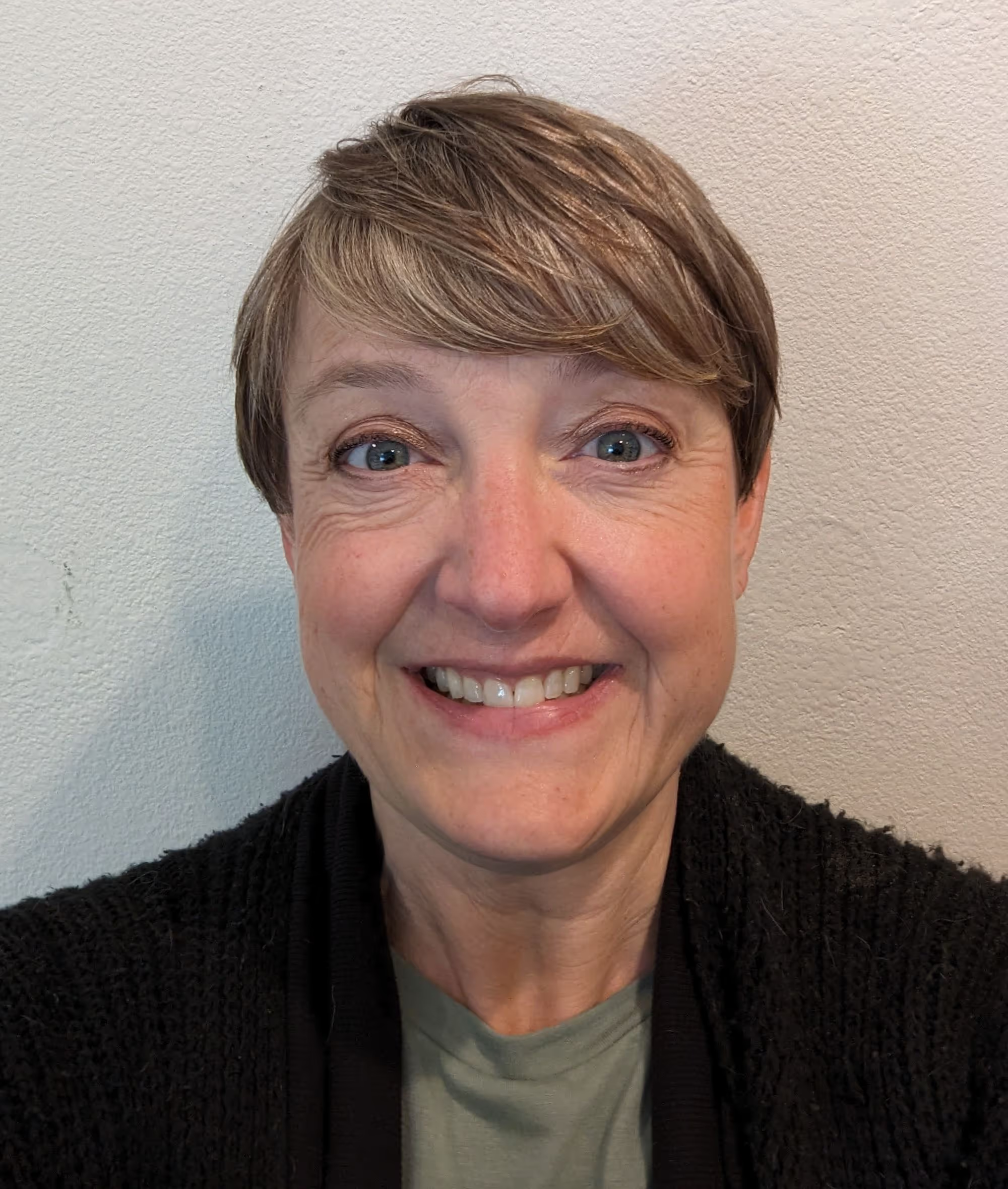
Allison Batty-Capps is a consciousness catalyst, spiritual teacher, and transmitter of Divine Human embodiment. She is a licensed mental health therapist, Reiki Master, Yoga Coach and spiritual channeler. She works at the intersection of psychology, mysticism, shadow alchemy, and God-consciousness, offering teachings that unify the human and the divine.
Her work is not about healing people — it is about awakening them.
Her presence carries a frequency that reminds others of their inherent sovereignty, their inner wisdom, and their direct connection to the Divine.
Through her books, teachings, sessions, and transmissions, Allison guides people into the maturity of spiritual adulthood — where compassion meets boundaries, love meets truth, and the soul meets the body.
She is devoted to helping humanity evolve beyond fear, beyond hierarchy, and beyond old paradigms of spirituality into a new era of embodied consciousness.
Allison lives what she teaches.
Her life reveals what unfolds when a person remembers they are not alone or separate, but a wave formed from the infinite ocean of God’s consciousness.
Join the Community!
Receive wellness tips, resources, book updates, and more directly in your inbox!
Related Posts
Manifestation, Healing, and the Vibration We Bring to Our Choices
When the Chaos of the Public Sphere Enters Our Nervous System