How do we measure spiritual maturity?

One of the things I find most fascinating about spirituality is that deeply spiritual people can hold completely different beliefs about reality.
Some believe we are creating our own reality.
Some believe the physical world is an illusion.
Some believe we are here to awaken consciousness.
Some believe we are here to heal karma across lifetimes.
Some believe Jesus will return and save humanity.
Some believe we are expressions of divine consciousness experiencing itself.
Others hold completely different perspectives.
And yet, many of these people would describe themselves as seeking truth, connection with the divine, or a deeper understanding of existence.
For much of my own spiritual journey, I found myself searching for the “right” understanding of reality.
I wanted to understand consciousness.
I wanted to understand God.
I wanted to understand mystical experiences.
I wanted to understand why suffering exists and what it means to be human.
Those questions have shaped much of my adult life.
I have studied spirituality, psychology, neuroscience, trauma healing, meditation, yoga, Reiki, Internal Family Systems theory, Buddhism, shamanic practices, contemplative Christianity, and mystical experiences.
And while I have found profound wisdom in many different traditions, I have also found myself returning to a question that feels even more important than what is true about reality?
The question is:
What kind of person does this belief help me become?
The Search for the Right Answer
There was a time when I believed healing meant finding the right answers.
If I could just understand reality correctly…
If I could find the right spiritual teaching…
If I could fully understand consciousness…
If I could transcend my suffering…
Then perhaps I would finally feel at peace.
And I understand why we are drawn toward certainty.
The human mind naturally wants to make sense of our experiences.
Especially after trauma.
Especially after loss.
Especially after moments when life feels unpredictable or painful.
Understanding can create a sense of safety.
Meaning can help us survive difficult experiences.
And I believe there is tremendous value in seeking wisdom.
But over time, I noticed something important.
Knowing more did not always mean becoming more loving.
Having profound spiritual experiences did not automatically mean becoming more compassionate.
Understanding concepts about consciousness did not necessarily mean embodying greater consciousness.
And that realization changed the way I understand spiritual growth.
Insight Is Not the Same as Transformation
One of the most important things I have learned through psychology and trauma healing is that insight matters—but insight alone does not create transformation.
We can understand intellectually why we react the way we do.
We can understand our childhood wounds.
We can understand our nervous system patterns.
We can understand spiritual principles.
But understanding something and embodying something are different experiences.
A person can know everything about compassion and still struggle to practice compassion.
A person can talk about love and still create harm in relationships.
A person can have profound mystical experiences and still avoid accountability.
This is not a criticism.
It is simply part of being human.
Transformation happens through integration.
It happens when awareness moves from an idea into our body, our relationships, our choices, and the way we treat other people.
The Question I Keep Returning To
After years of studying spirituality and psychology, I have become less interested in asking:
“Who is right?”
And more interested in asking:
“What is this belief creating?”
Does this belief help someone become:
- More compassionate?
- More humble?
- More honest?
- More curious?
- More willing to listen?
- More capable of repairing harm?
- More present with suffering?
Or does it lead someone toward:
- Feeling superior to others?
- Believing they no longer need to grow?
- Avoiding difficult emotions?
- Disconnecting from people who disagree?
- Losing compassion for human struggle?
Again, I am not suggesting that a person’s spiritual beliefs are wrong simply because they differ from mine.
Different people find meaning through different paths.
Different traditions speak to different hearts.
Different nervous systems need different forms of healing.
But I do think every spiritual path deserves honest reflection.
Because beliefs shape the way we relate to ourselves and others.
Spirituality Should Bring Us Closer to Humanity
One of the patterns I have noticed in some spiritual communities is that there can sometimes be an emphasis on moving beyond the human experience.
Beyond the ego.
Beyond emotions.
Beyond suffering.
And I understand the wisdom behind these teachings.
There are parts of ourselves that are larger than our wounds.
There are moments when we experience connection beyond our individual identity.
There are profound states of consciousness that can transform the way we see ourselves and the world.
I have experienced this myself.
But I also believe something equally important:
We are still human.
We still have bodies.
We still have nervous systems.
We still have relationships.
We still experience grief, anger, fear, disappointment, and uncertainty.
Perhaps spiritual maturity is not about escaping humanity.
Perhaps it is about bringing more awareness and love into our humanity.
Psychology and Spirituality Meeting Together
From a psychological perspective, this makes sense.
Our nervous systems do not transform simply because we adopt a new belief.
Healing happens through experiences of:
- Safety
- Connection
- Reflection
- Accountability
- Compassion
- Repair
A person can believe they are connected to divine consciousness, but if they are unable to listen to another person's pain, something may still need attention.
A person can understand the concept of unconditional love, but if they cannot offer kindness toward themselves, there may still be a wound asking for care.
This is why I believe spirituality and psychology can support one another.
Spirituality reminds us that we are more than our wounds.
Psychology reminds us that our wounds still need compassion.
Spirituality invites us into connection with something greater.
Psychology helps us understand how we can embody that connection in everyday life.
The Measure of Spiritual Growth
I have met people who have had extraordinary spiritual experiences.
They have experienced mystical states.
They have profound insights.
They have powerful beliefs about consciousness.
And I have also met people with very simple spiritual practices whose kindness and compassion deeply impacted everyone around them.
That has taught me something.
Maybe spiritual maturity is not measured by how much someone knows.
Maybe it is measured by how someone lives.
Can they apologize?
Can they listen?
Can they remain open when challenged?
Can they hold boundaries without losing compassion?
Can they acknowledge another person's humanity even when they disagree?
Can they admit when they are wrong?
Can they continue learning?
To me, these are signs of a spirituality that is alive.
Embodying the Divine Within
The title of my book, The Divine Within: Healing Ourselves to Heal the World, reflects something I deeply believe:
The divine is not only something we seek outside ourselves.
It is something we learn to embody.
Not by becoming perfect.
Not by becoming someone else.
Not by escaping our humanity.
But by becoming more fully ourselves.
More compassionate.
More conscious.
More connected.
More willing to meet ourselves and others with love.
A Different Question for Our Spiritual Paths
Maybe instead of only asking:
“Which spiritual teaching is correct?”
We might also ask:
“What kind of person does this teaching help me become?”
Does it help me love more deeply?
Does it help me create less harm?
Does it help me become more honest?
Does it help me live with greater integrity?
Does it help me stay connected to myself and others?
Because perhaps the deepest measure of spirituality is not how much we understand about the universe.
Perhaps it is how much love we are able to bring into the small moments of everyday life.
Continuing the Conversation
I don't believe we all need to agree about spirituality.
In fact, I think our differences can be opportunities for deeper understanding.
But I do believe we can ask better questions together.
Questions that move us beyond proving ourselves right and toward becoming more compassionate human beings.
So I would love to hear your thoughts:
What qualities do you think reflect genuine spiritual maturity?
Is it wisdom?
Compassion?
Humility?
Presence?
Love?
The ability to remain open?
I'd love to explore these questions with you.
If you would like to go deeper into the intersection of spirituality, psychology, neuroscience, and healing, I invite you to explore my book, The Divine Within: Healing Ourselves to Heal the World, or visit Blossoming Heart Wellness to learn more about my approach to therapy, wellness coaching, and spiritual mentorship.
My hope is not that we all arrive at the same answers.
My hope is that we continue asking questions that bring us closer to ourselves, closer to one another, and closer to love.
About The Author
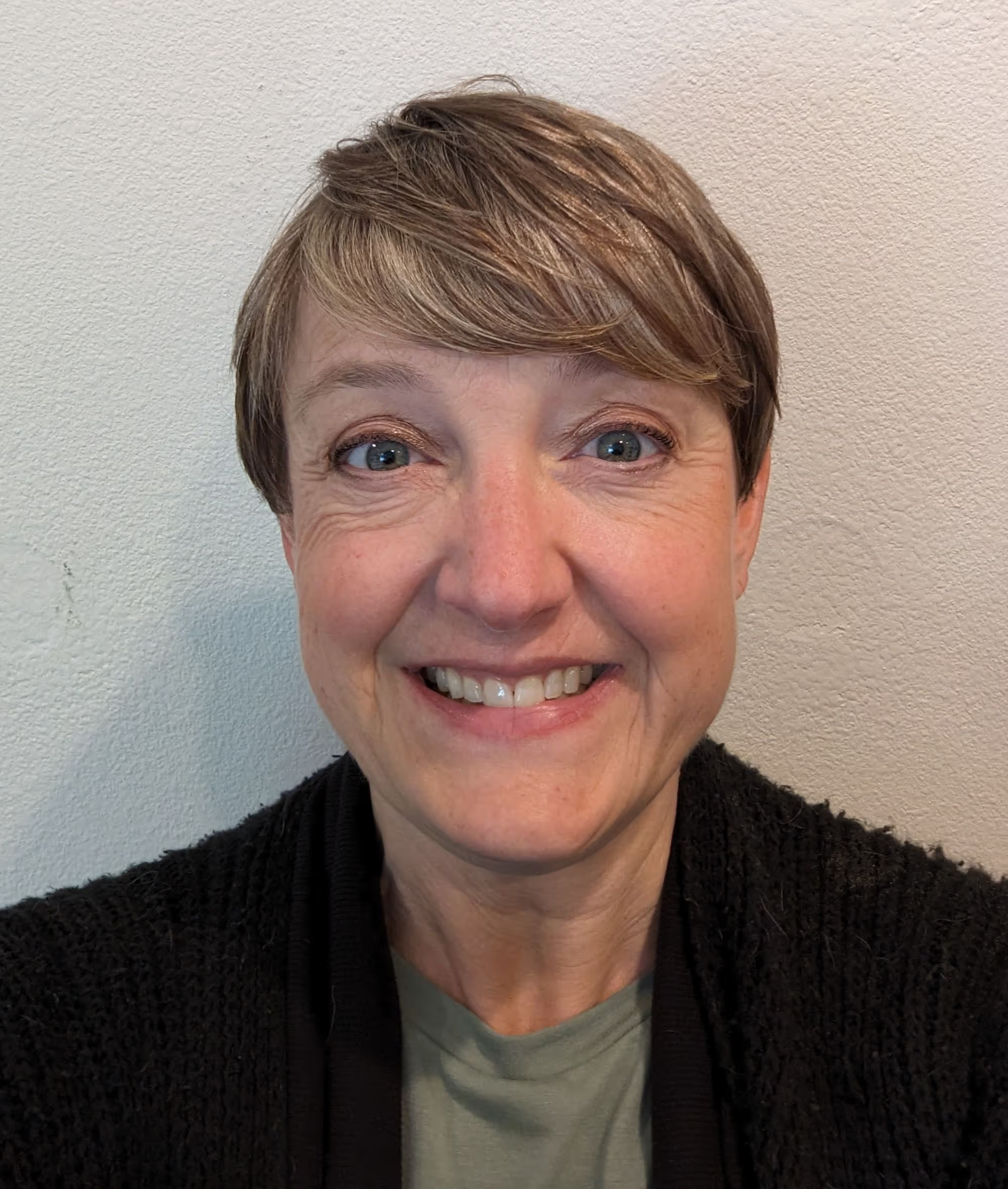
Allison Batty-Capps is a consciousness catalyst, spiritual teacher, and transmitter of Divine Human embodiment. She is a licensed mental health therapist, Reiki Master, Yoga Coach and spiritual channeler. She works at the intersection of psychology, mysticism, shadow alchemy, and God-consciousness, offering teachings that unify the human and the divine.
Her work is not about healing people — it is about awakening them.
Her presence carries a frequency that reminds others of their inherent sovereignty, their inner wisdom, and their direct connection to the Divine.
Through her books, teachings, sessions, and transmissions, Allison guides people into the maturity of spiritual adulthood — where compassion meets boundaries, love meets truth, and the soul meets the body.
She is devoted to helping humanity evolve beyond fear, beyond hierarchy, and beyond old paradigms of spirituality into a new era of embodied consciousness.
Allison lives what she teaches.
Her life reveals what unfolds when a person remembers they are not alone or separate, but a wave formed from the infinite ocean of God’s consciousness.
Join the Community!
Receive wellness tips, resources, book updates, and more directly in your inbox!
Related Posts
.png)
What If Our Political Divisions Reflect Our Unhealed Relationship Patterns?
When the Body Remembers
.png)