When Your Parts Don’t Want to Be Healed
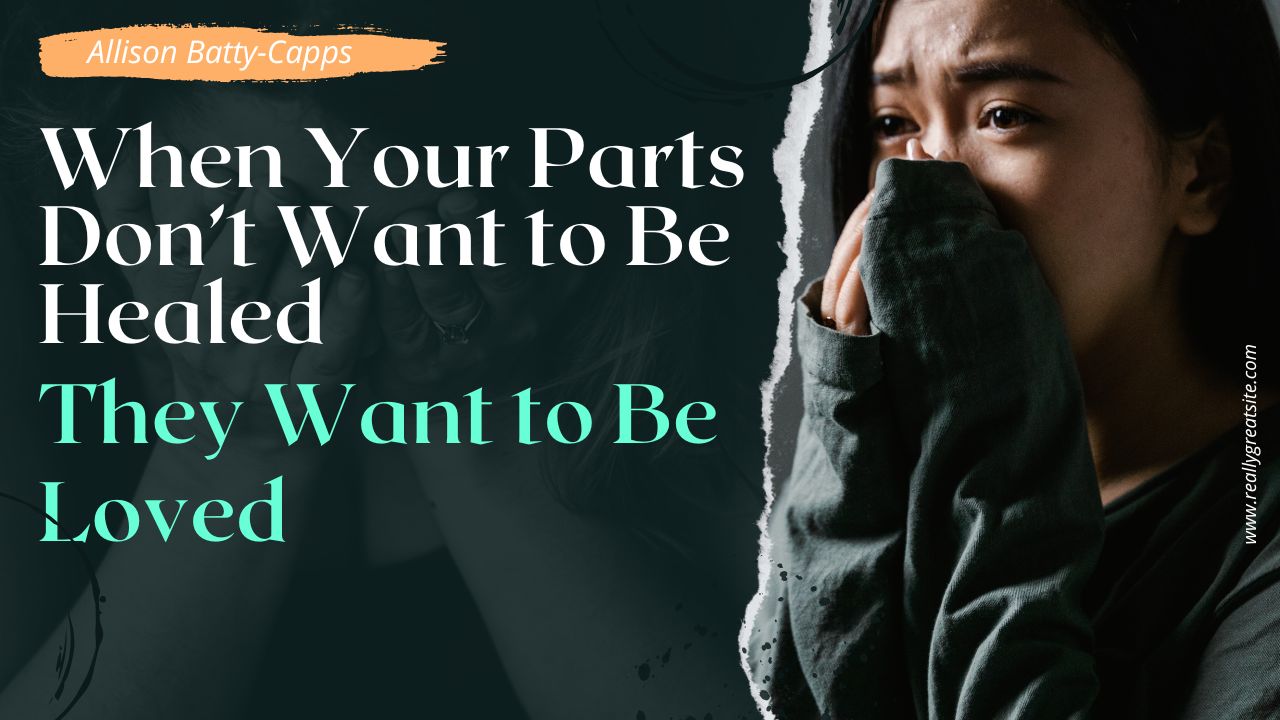
By Allison Batty-Capps | Blossoming Heart Wellness
Hello, beautiful sacred souls. Today, I want to explore a transformative concept in trauma-informed healing: what if your parts—or your ego—don’t want to be “fixed,” they want to be loved?
For many of us, the journey of healing has been framed around self-improvement, growth, and transcendence. We are taught to identify flaws, “heal” our trauma, or correct our behavior. While well-intentioned, these frameworks can sometimes overlook the profound truth that our inner parts are not broken—they are protective, adaptive, and worthy of love.
In this blog, I’ll share insights from spirituality, psychology, and neuroscience, illustrating how loving your inner parts can create profound healing, integration, and self-belonging.
Understanding Your Inner System
Internal Family Systems (IFS) theory teaches us that the mind is composed of distinct “parts”—subpersonalities that often carry unresolved trauma, pain, or survival adaptations. These parts may hold fear, anger, shame, or grief. Your ego is one of these parts, often the one trying to manage or protect the system as a whole.
For many of us, these parts resist “healing” because they feel unsafe. They fear judgment, shame, or rejection. They have spent years—or decades—protecting us through behaviors that may seem maladaptive in adulthood, like perfectionism, people-pleasing, aggression, or avoidance.
The pivotal realization I came to is this: these parts don’t need to be fixed—they need to be loved.
Trauma Adaptations Are Brilliant, Not Broken
Trauma adaptations are survival strategies. They allowed us to cope with overwhelming experiences, navigate unsafe environments, and even create connection when it was absent.
- Protective behaviors such as hyper-vigilance or withdrawal were once essential for safety.
- Caretaking or people-pleasing was a way to maintain connection and reduce harm.
- Emotional shutdown or anger often arose to assert boundaries and create protection.
When we approach these adaptations from curiosity, compassion, and presence, they begin to soften. Healing does not come from coercion, self-judgment, or pressure—it comes from connection and safety.
The Neuroscience of Love and Healing
Neuroscience confirms what trauma-informed psychology teaches: the nervous system responds to safety and threat.
- When a part feels unsafe, the amygdala—the brain’s threat detector—activates, triggering fight, flight, freeze, or fawn responses.
- When a part feels seen, safe, and loved, the prefrontal cortex re-engages, enabling empathy, choice, and moral clarity.
In other words, love changes the brain. It reorganizes neural pathways, reduces reactivity, and allows protective parts to relax their grip. This is why healing from within is profoundly relational and biological, not just intellectual.
Healing Through Presence, Not Fixing
Many spiritual and self-help teachings suggest that something inside us is “broken” and must be corrected. Trauma-informed work invites a different perspective: your parts are not the problem—they are asking to be loved.
By practicing loving presence:
- Parts feel acknowledged and safe.
- Survival strategies begin to soften and integrate.
- Harmful patterns that once protected us shift naturally.
- Inner guidance and moral clarity emerge spontaneously.
This approach doesn’t excuse harmful behavior, nor does it replace accountability. Instead, it recognizes that when a nervous system is regulated, choice becomes possible. Compassion allows us to respond rather than react.
Bridging Love and Accountability
It’s important to clarify: loving your parts does not mean excusing harmful behavior—your own or others’. Trauma shapes behavior, but harm is real and must be addressed. True healing includes:
- Acknowledging the impact of actions
- Repairing relationships and boundaries
- Taking responsibility without shame or self-punishment
- Building empathy and moral clarity
When parts feel safe, accountable action arises naturally. The nervous system can regulate, empathy expands, and choices are guided by care rather than fear. This is how love becomes a catalyst for genuine transformation.
The Spiritual Perspective
From a spiritual lens, loving your parts reflects the truth that your humanity is sacred. You are not required to transcend your human emotions, flaws, or wounds to be worthy.
Healing is not about self-transcendence or perfection—it is about self-belonging. By creating an inner environment of safety, acceptance, and love:
- Your system integrates rather than suppresses trauma.
- Your body and mind collaborate rather than conflict.
- Inner clarity, compassion, and empathy flourish.
This approach bridges spirituality, psychology, and neuroscience, offering a holistic path toward integration.
Practical Steps to Love Your Parts
- Notice protective behaviors without judgment.
- Pause and acknowledge the part that is activated.
- Offer compassionate presence: “I see you. You are safe. You are loved.”
- Listen for underlying needs or fears instead of trying to fix the part.
- Integrate gradually: let the part relax and participate in decisions from a place of safety.
Over time, your parts naturally align with your inner compass, and healing becomes a relational, embodied process.
Closing Thoughts
Healing is not about fixing yourself. Healing is about loving your parts, creating internal safety, and allowing the nervous system to soften. From this place, genuine accountability, empathy, and integration emerge.
Your parts don’t need to be completely healed—they need to be seen, heard, and loved. When they are, transformation happens organically, not from pressure or coercion, but from connection.
📖 For a deeper dive into trauma-informed healing, parts integration, and cultivating self-belonging, read my book: The Divine Within: Healing Ourselves to Heal the World.
🌐 Visit Blossoming Heart Wellness to explore blogs, online courses, and newsletters to support your journey.
💛 Remember, your sensitivity, humanness, and longing for connection are not flaws—they are gateways to profound healing.
About The Author
Allison Batty-Capps is a consciousness catalyst, spiritual teacher, and transmitter of Divine Human embodiment. She is a licensed mental health therapist, Reiki Master, Yoga Coach and spiritual channeler. She works at the intersection of psychology, mysticism, shadow alchemy, and God-consciousness, offering teachings that unify the human and the divine.
Her work is not about healing people — it is about awakening them.
Her presence carries a frequency that reminds others of their inherent sovereignty, their inner wisdom, and their direct connection to the Divine.
Through her books, teachings, sessions, and transmissions, Allison guides people into the maturity of spiritual adulthood — where compassion meets boundaries, love meets truth, and the soul meets the body.
She is devoted to helping humanity evolve beyond fear, beyond hierarchy, and beyond old paradigms of spirituality into a new era of embodied consciousness.
Allison lives what she teaches.
Her life reveals what unfolds when a person remembers they are not alone or separate, but a wave formed from the infinite ocean of God’s consciousness.

Join the Community!
Receive wellness tips, resources, book updates, and more directly in your inbox!
Related Posts
.png)
What If Our Political Divisions Reflect Our Unhealed Relationship Patterns?
When the Body Remembers
.png)