Stability Is Not the Absence of Chaos
There is a widely held belief in both spiritual and mental health spaces that healing means arriving at a place where life becomes calm, predictable, and internally peaceful all the time.
No more overwhelm.
No more emotional activation.
No more instability.
But in lived experience—and in neuroscience, psychology, and trauma-informed understanding—that is not what healing actually looks like.
Stability is not the absence of chaos. It is the capacity to stay present within it.
This is a radically different definition of healing. And for many people, it is a much more compassionate and realistic one.
Beginning With a Grounded Truth
Before anything else, it is important to acknowledge something real:
Life does not stop being life when we heal.
We still experience:
- Stress
- Loss
- Change
- Uncertainty
- Emotional waves
- External instability
Healing does not remove these experiences.
Instead, it changes how we meet them internally.
And that distinction changes everything.
Healing Is Not Elimination—It Is Capacity
One of the most common misunderstandings about healing is the idea that it equals elimination:
- Eliminate anxiety
- Eliminate triggers
- Eliminate emotional activation
- Eliminate instability
But from a neuroscience perspective, the brain and nervous system do not evolve toward a stress-free state.
They evolve toward adaptability.
This is where the concept of neuroplasticity becomes essential.
Neuroplasticity is the brain’s ability to:
- Reorganize
- Adapt
- Form new pathways
- Recover from stress more efficiently over time
So healing is not the absence of activation.
It is:
The increased capacity to move through activation without losing yourself inside it.
What Actually Changes When You Heal
If healing is not the removal of stress, then what actually changes?
For many people, including those with histories of trauma, mental health challenges, or nervous system overwhelm, the shifts are often subtle but profound:
- Greater awareness of internal states
- Increased ability to pause before reacting
- Improved emotional regulation
- Faster return to baseline after stress
- Less shame when activation happens
- More internal coherence during difficulty
You are not becoming someone who never struggles.
You are becoming someone who can stay connected to themselves while they do.
This is integration.
A Nervous System Perspective: Why This Matters
The nervous system is constantly scanning for cues of safety or threat.
When something feels overwhelming, the body may move into:
- Fight
- Flight
- Freeze
- Fawn
These responses are not conscious choices. They are protective survival strategies.
When we experience repeated stress or trauma, the nervous system can become:
- More reactive
- More sensitive to perceived threat
- More likely to escalate quickly
- More prone to shutdown or overwhelm
Healing, then, is not about never activating these responses again.
It is about:
- Increasing awareness earlier in the process
- Reducing escalation intensity
- Shortening recovery time
- Expanding the “window of tolerance”
In other words:
The system becomes less easily overwhelmed, and more able to return to regulation.
Integration: The Psychological Lens
Psychology often describes this shift as integration.
Integration means:
- You can observe your internal states without becoming them
- You can feel emotion without being consumed by it
- You can hold complexity without fragmentation
It is not detachment.
It is not suppression.
It is the ability to say:
“Something in me is activated… and I am still here.”
This creates a profound shift in identity—from being the emotion to witnessing the emotion.
A Spiritual Perspective: Presence Inside Experience
From a spiritual lens, this shift is sometimes described as:
- Presence
- Awareness
- Witness consciousness
- Non-identification with passing states
But this is not about transcending human experience or bypassing emotion.
It is about something more grounded:
Staying in relationship with yourself through everything you experience.
Not escaping intensity.
Not rejecting emotion.
But remaining present within it.
This is where compassion, choice, and grounding become available—even in difficult moments.
My Lived Experience: What This Looks Like in Real Life
I share this not as theory, but as lived experience.
I have a history of serious mental health challenges, including episodes of psychosis and periods of significant instability.
And I also now experience something different in my life:
Not perfection.
Not immunity.
Not constant calm.
But capacity.
Right now, my life includes:
- Financial uncertainty
- An international move
- Family health challenges
- Emotional waves and stress
These are real.
And I still have moments where life feels overwhelming.
But what has changed is not the absence of difficulty.
What has changed is:
The absence of total internal collapse in response to difficulty.
There is more ability to:
- Stay present
- Regulate in real time
- Return to myself after activation
- Hold emotional complexity without losing coherence
This is what healing looks like from the inside.
Stability vs. Collapse: A Crucial Distinction
One of the most important distinctions in trauma-informed healing is this:
External instability does not have to equal internal collapse.
Life can be unstable.
Circumstances can be uncertain.
Emotions can be intense.
And yet the internal system can still develop:
- Anchoring
- Awareness
- Regulation
- Return
This is the real marker of healing.
Not the absence of challenge.
But the presence of capacity within challenge.
Why This Matters for Mental Health Recovery
For people with histories of:
- Trauma
- Psychosis
- Anxiety disorders
- Emotional overwhelm
- Chronic stress responses
This distinction is essential.
Because if we believe healing means “never feeling overwhelmed again,” we set ourselves up for:
- Shame
- Self-blame
- Hopelessness
- Feeling like we are failing
But if we understand healing as capacity-building, then everything changes.
We begin to see:
- Activation is not failure
- Overwhelm is not regression
- Emotional waves are not evidence of brokenness
Instead, we begin to ask:
“How quickly can I come back to myself?”
That is the real measure of growth.
The Nervous System Is Always Learning
One of the most hopeful truths in neuroscience is this:
The nervous system is always capable of change.
Even after trauma.
Even after long-term dysregulation.
Even after years of overwhelm.
Through repeated experiences of:
- Safety
- Awareness
- Regulation
- Support
- Compassion
The system learns something new.
Not that life is always easy.
But that:
“I can move through this and come back to myself.”
A New Definition of Healing
Perhaps we can redefine healing in a way that is more grounded and humane:
Healing is not:
- Never being triggered
- Never feeling overwhelmed
- Never struggling
Healing is:
The ability to stay connected to yourself while life moves through you.
It is:
- Presence inside chaos
- Regulation inside activation
- Awareness inside emotion
- Connection inside uncertainty
Closing Reflection
If you are in a place of struggle right now, or if life feels unstable, I want to offer this gently:
You are not behind.
You are not broken.
You are not failing.
You may simply be in the process of building capacity in a system that was once overwhelmed.
And capacity is not built in a moment.
It is built over time.
Through repetition.
Through awareness.
Through coming back again and again.
Not perfectly.
But consistently enough for the nervous system to learn:
“I can return.”
And that changes everything.
To go deeper read The Divine Within: Healing Ourselves to Heal the World or visit www.blossomingheartwellness.com
About The Author
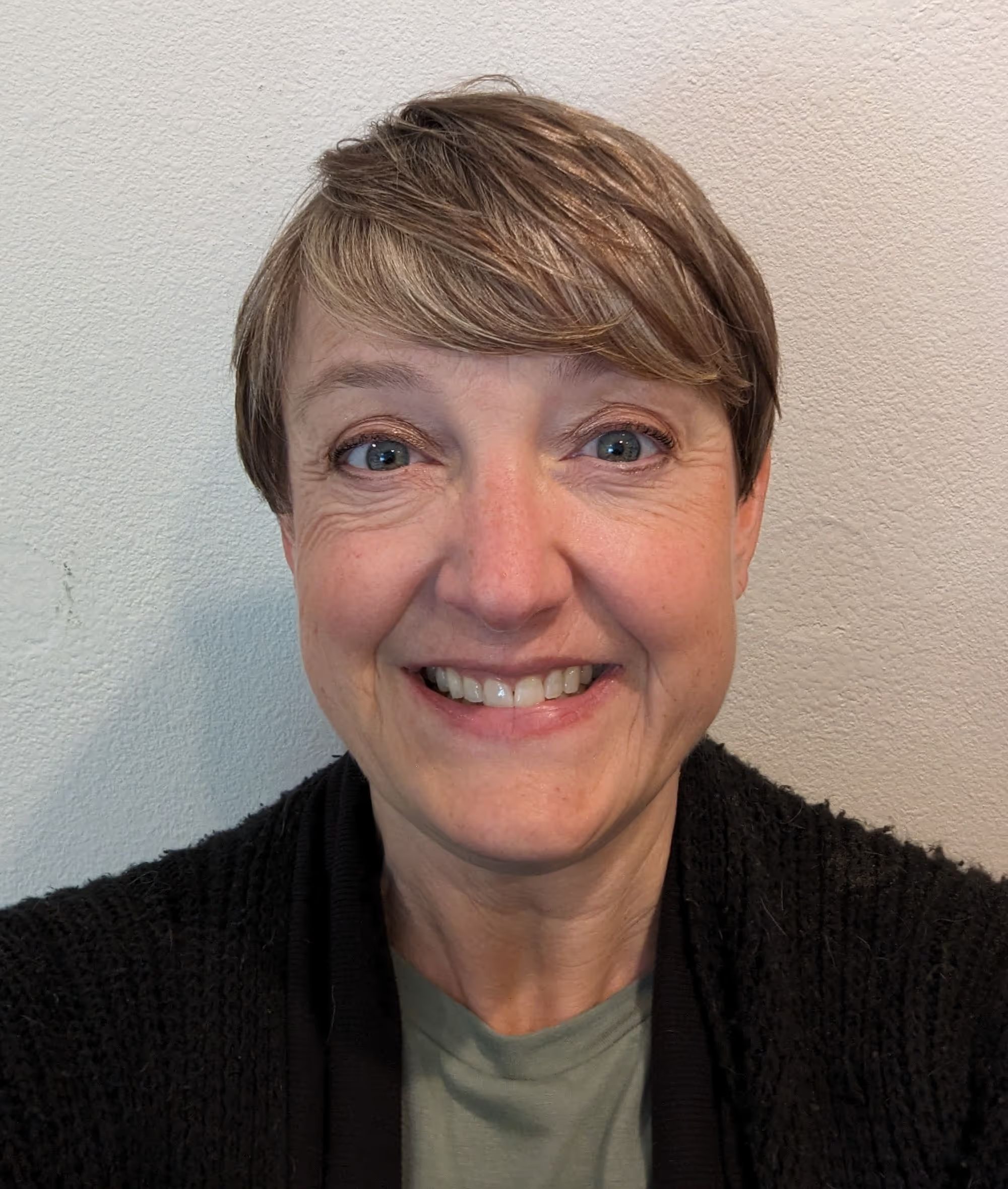
Allison Batty-Capps is a consciousness catalyst, spiritual teacher, and transmitter of Divine Human embodiment. She is a licensed mental health therapist, Reiki Master, Yoga Coach and spiritual channeler. She works at the intersection of psychology, mysticism, shadow alchemy, and God-consciousness, offering teachings that unify the human and the divine.
Her work is not about healing people — it is about awakening them.
Her presence carries a frequency that reminds others of their inherent sovereignty, their inner wisdom, and their direct connection to the Divine.
Through her books, teachings, sessions, and transmissions, Allison guides people into the maturity of spiritual adulthood — where compassion meets boundaries, love meets truth, and the soul meets the body.
She is devoted to helping humanity evolve beyond fear, beyond hierarchy, and beyond old paradigms of spirituality into a new era of embodied consciousness.
Allison lives what she teaches.
Her life reveals what unfolds when a person remembers they are not alone or separate, but a wave formed from the infinite ocean of God’s consciousness.
Join the Community!
Receive wellness tips, resources, book updates, and more directly in your inbox!
Related Posts
.png)
What If Our Political Divisions Reflect Our Unhealed Relationship Patterns?
When the Body Remembers
.png)