Did We Choose Our Parents?
.png)
For many people on a spiritual path, the idea that we “chose our parents” or “chose our family” before birth can feel both intriguing and deeply unsettling—especially for those who grew up with trauma, neglect, or abuse.
If you’ve ever heard teachings suggesting that souls choose their life circumstances for growth, you may have wondered:
- Did I choose this pain?
- Did I choose to be hurt?
- Does believing this mean I’m responsible for what happened to me?
These are important questions. And they deserve to be explored with discernment, compassion, and a trauma-informed lens, not spiritual bypassing or blame.
In this article, I want to gently explore the concept of choosing our parents or family circumstances while honoring the very real impact of trauma, intergenerational patterns, and nervous system survival responses.
This is not about absolute truth or dogma. It is an invitation to curiosity—held with grounding, safety, and respect for your lived experience.
A Trauma-Informed Framework for Spiritual Inquiry
My work bridges spirituality, psychology, neuroscience, and trauma recovery. Everything I share comes from lived experience, education, and years of personal healing.
Nothing here is meant to:
- Replace therapy or medical care
- Diagnose or interpret your experience
- Override your own discernment
You are always the authority of your own experience.
If spiritual language brings up fear, urgency, shame, or distress in your body, that is a sign to pause, ground, and seek trauma-informed support—not to push through.
True spiritual growth supports nervous system safety, not spiritual pressure.
The Spiritual Idea of Choosing Our Parents
Some spiritual traditions suggest that souls choose their families as part of a larger learning journey. From this perspective, life circumstances are not punishments, but opportunities for growth, compassion, and awakening.
When approached gently, this idea can invite curiosity:
- Why did I come into this family system?
- What patterns am I here to witness or transform?
- What resilience or wisdom might emerge from my healing?
However, without a trauma-informed lens, this teaching can quickly become harmful—especially when applied to survivors of abuse.
So it is essential to name this clearly:
Choosing a family does NOT mean choosing abuse.
Choosing a family does NOT mean deserving harm.
Choosing a family does NOT absolve others of accountability.
Intergenerational Trauma and the Reality of Family Systems
From a trauma-informed perspective, families often carry unresolved intergenerational trauma—biologically, emotionally, and psychologically.
Patterns of neglect, emotional unavailability, boundary violations, or abuse are often not intentional cruelty, but inherited survival strategies passed down through generations.
That said, understanding trauma does not excuse harm.
Each parent has free will.
Each caregiver has responsibility.
Each adult has the opportunity to seek healing before passing pain forward.
When harm occurs, it is not because a child “chose abuse.”
It is because the adults responsible did not have—or did not use—the tools for healing and accountability.
We can hold compassion for limitations and name harm clearly.
Choice, Free Will, and Reclaiming Agency
One of the most important distinctions in this conversation is between context and outcome.
You may have been born into a family with intergenerational trauma, but that does not guarantee abuse. Trauma is not destiny.
Free will matters.
When trauma does occur, healing involves reclaiming agency:
- Recognizing patterns without self-blame
- Understanding how survival responses formed
- Choosing different ways of relating, responding, and setting boundaries
This is where spiritual insight and trauma healing meet.
Not to erase pain—but to transform how it lives in the body.
The Nervous System: Why Healing Requires Safety
Our nervous systems inherit survival strategies from our families. These patterns can show up as:
- Hypervigilance
- Emotional shutdown
- Fawning or people-pleasing
- Difficulty trusting or setting boundaries
Healing cannot happen if the nervous system is constantly re-exposed to unsafe dynamics.
This is why boundaries are not punishments.
They are acts of nervous system protection.
For some people, healing means redefining relationships.
For others, it means limited contact.
And for some, no contact is the safest option.
Choosing safety is not failure.
It is self-respect.
Healing Family Karma Without Blame
Healing does not require fixing your parents or carrying responsibility for their healing.
It begins by:
- Witnessing intergenerational patterns without judgment
- Holding individuals accountable for their actions
- Choosing not to perpetuate harm
When you heal your nervous system, you interrupt cycles of trauma—not just for yourself, but for future generations.
This is how inner work creates outer change.
Reparenting Yourself: A Path to Freedom
Reparenting is the process of giving yourself what was missing:
- Safety
- Attunement
- Validation
- Compassion
- Boundaries
Through trauma-informed practices, the nervous system learns:
- I am allowed to protect myself.
- I can feel without being overwhelmed.
- I do not have to repeat what I inherited.
This is not about rejecting your family.
It is about choosing a different future.
Practical Ways to Integrate This Work
If this exploration resonates, you might gently begin with:
- Journaling about inherited patterns and how they show up today
- Noticing nervous system responses in family interactions
- Learning regulation tools to process intense emotions safely
- Practicing boundary-setting without shame
- Reframing family history with compassion and clarity
This work is both spiritual and psychological. It restores agency, dignity, and embodiment.
A Gentle Closing Invitation
Mystical experiences, spiritual insights, and healing journeys are deeply personal. They are best approached slowly, with grounding and trauma-informed support.
True spirituality does not disconnect us from reality or the body.
It helps us inhabit life more fully—with presence, compassion, and discernment.
If you’re interested in deeper support, I offer:
- Trauma-informed mentorship
- An online course
- My book, The Divine Within: Healing Ourselves to Heal the World, which bridges spirituality, psychology, and neuroscience and includes practical exercises for nervous system healing, reparenting, and breaking trauma patterns. Available on amazon, barnes and noble, walmart, powell's books and other online stores
You are not broken.
You did not choose suffering.
And healing is possible—at your pace, in your body, with safety.
Thank you for being here and for honoring your nervous system.
Sending you deep compassion wherever you are on your healing journey.
About The Author
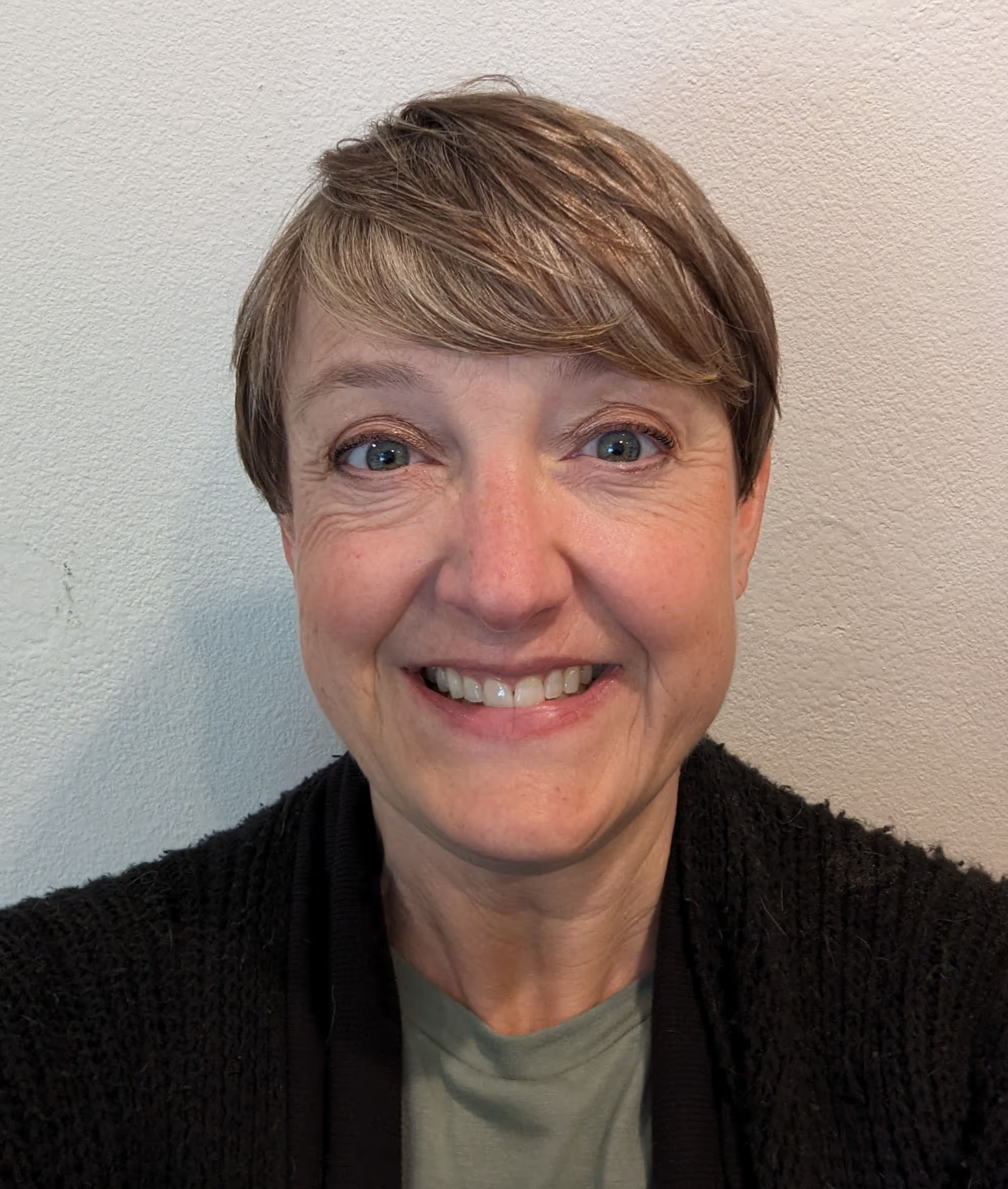
Allison Batty-Capps is a consciousness catalyst, spiritual teacher, and transmitter of Divine Human embodiment. She is a licensed mental health therapist, Reiki Master, Yoga Coach and spiritual channeler. She works at the intersection of psychology, mysticism, shadow alchemy, and God-consciousness, offering teachings that unify the human and the divine.
Her work is not about healing people — it is about awakening them.
Her presence carries a frequency that reminds others of their inherent sovereignty, their inner wisdom, and their direct connection to the Divine.
Through her books, teachings, sessions, and transmissions, Allison guides people into the maturity of spiritual adulthood — where compassion meets boundaries, love meets truth, and the soul meets the body.
She is devoted to helping humanity evolve beyond fear, beyond hierarchy, and beyond old paradigms of spirituality into a new era of embodied consciousness.
Allison lives what she teaches.
Her life reveals what unfolds when a person remembers they are not alone or separate, but a wave formed from the infinite ocean of God’s consciousness.
Join the Community!
Receive wellness tips, resources, book updates, and more directly in your inbox!
Related Posts
Rupture and Repair
When the World Reopens Old Wounds
.jpg)