Can Spirituality Accidentally Shame People Who Are Trying to Heal?
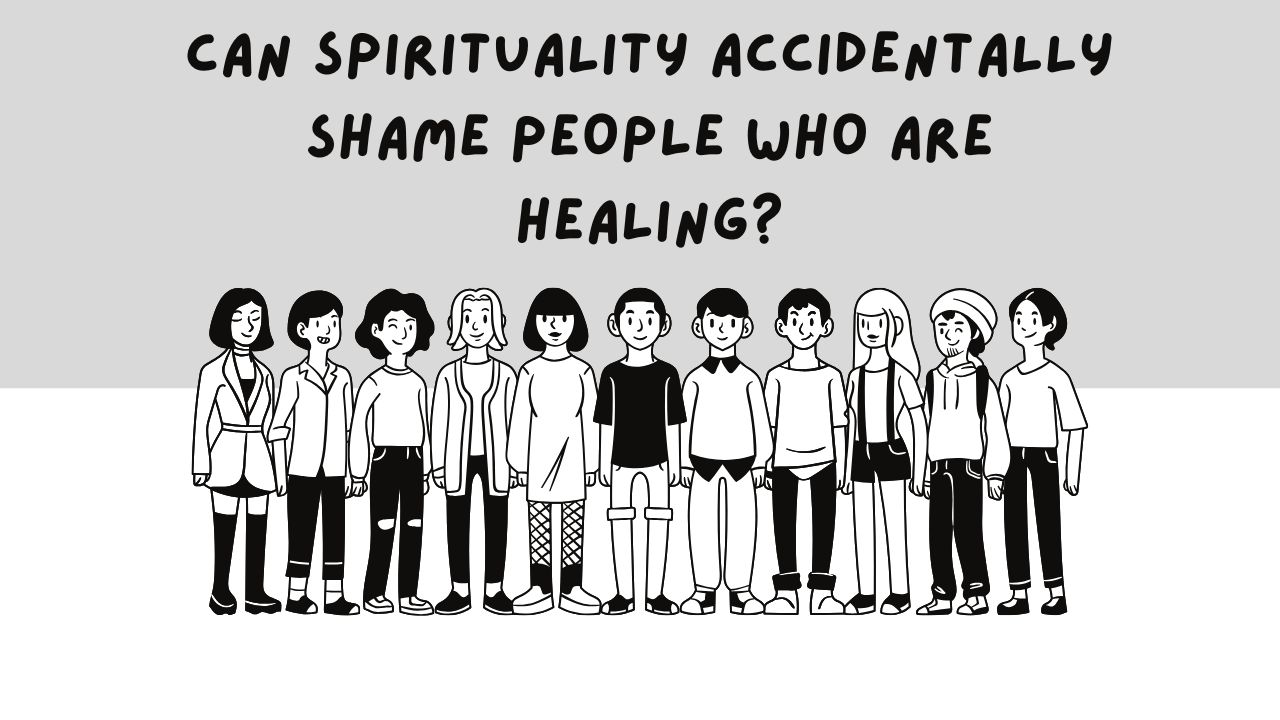
One question has been quietly following me lately:
Can spirituality accidentally make people feel ashamed for being human?
It isn't a question I ask because I reject spirituality. Quite the opposite.
My life has been profoundly transformed by spiritual practice. It has helped me cultivate greater compassion, experience moments of deep connection, and find meaning in some of the most painful chapters of my life.
But over the years—as both a licensed marriage and family therapist and someone who has lived with complex trauma and significant mental health challenges—I have also noticed something that I think deserves gentle exploration.
Sometimes teachings that are intended to inspire hope can unintentionally create shame.
Not because they are malicious.
Not because they are entirely wrong.
But because they may be incomplete.
When Hope Becomes a Measuring Stick
If you've spent any time in spiritual communities, you've probably encountered messages like:
- "As your consciousness evolves, fear disappears."
- "High-vibrational people don't react that way."
- "You're attracting your reality based on your frequency."
- "When you're truly awakened, nothing can disturb your peace."
I understand the intention behind these ideas.
Most people sharing them genuinely want to encourage others. They want people to experience greater freedom, less suffering, and deeper peace.
Those are beautiful aspirations.
But I also find myself wondering what happens when someone who is living with complex PTSD reads those words.
Or someone grieving the death of a loved one.
Or someone whose nervous system has spent decades learning that the world isn't safe.
Or someone struggling with anxiety, depression, panic, or overwhelming stress.
If they continue experiencing fear, what conclusion might they quietly draw?
Perhaps:
"Maybe I'm not healing."
"Maybe I'm not spiritual enough."
"Maybe everyone else is evolving except me."
"Maybe something is wrong with me."
Those are painful conclusions.
And unfortunately, they are conclusions I know intimately.
When Fear Became Proof That I Was Failing
There was a season in my own life when I believed that if I was still afraid, I simply wasn't healing enough.
Every teaching about transcending fear, becoming higher vibration, or awakening more fully became another reason for my frightened parts to wonder whether they were defective.
Instead of bringing relief, some spiritual ideas unintentionally became another layer of pressure.
I wasn't just carrying trauma anymore.
I was carrying shame about having trauma.
That distinction matters.
Trauma already asks us to question whether we're safe.
Shame asks us to question whether we're worthy.
Those are very different wounds.
And when spiritual language accidentally reinforces shame, healing can become even harder.
Our Nervous Systems Tell a Different Story
One of the reasons I love studying neuroscience is that it often brings tremendous compassion into conversations that have become overly simplistic.
From a neuroscience perspective, fear is not evidence of failure.
Fear is evidence that your nervous system is doing exactly what it evolved to do.
The human brain is designed to detect potential danger.
That capacity never disappears.
Nor should it.
Without fear, we couldn't recognize genuine threats.
We couldn't protect ourselves.
We couldn't survive.
Healing doesn't erase fear.
Healing changes our relationship with fear.
That is a profoundly different goal.
Trauma Changes the Alarm System
For individuals who have experienced trauma, the nervous system often learns that danger exists where others may not immediately perceive it.
This isn't because the person is weak.
It's because their brain adapted to survive.
The amygdala becomes more sensitive.
Protective responses become stronger.
The body learns to prepare for danger quickly because, at one point, that adaptation may have been life-saving.
These responses aren't character flaws.
They're survival strategies.
Healing isn't about criticizing those strategies.
It's about gently helping the nervous system recognize when the present moment differs from the past.
Healing Isn't the Absence of Fear
One of the biggest shifts in my own healing wasn't that fear disappeared.
It didn't.
The difference is that fear no longer has the same authority over my life.
It still visits.
But it doesn't always become the driver.
There is more space now.
More curiosity.
More compassion.
More ability to pause before reacting.
Sometimes I can notice myself becoming activated and quietly say,
"Something in the present is reminding my nervous system of something from the past."
That single sentence creates room.
Room to breathe.
Room to choose.
Room to respond instead of simply react.
That feels much closer to healing than pretending fear no longer exists.
Compassion Changes the Brain
One of the most hopeful findings in neuroscience is that compassion isn't simply a beautiful spiritual ideal.
It literally changes how our brains respond to suffering.
Research suggests that compassionate practices can strengthen neural pathways associated with emotional regulation, empathy, resilience, and connection.
Compassion doesn't eliminate pain.
It changes how we meet pain.
Instead of asking,
"Why am I still struggling?"
Compassion asks,
"What happened that makes this response understandable?"
That question changes everything.
Because healing rarely grows through self-condemnation.
It grows through understanding.
What If Awakening Looks Different Than We Imagine?
Spiritually, I find myself wondering something.
What if awakening isn't about becoming fearless?
What if awakening is becoming more loving toward the parts of ourselves that still carry fear?
What if greater consciousness doesn't remove our humanity?
What if it helps us embrace it more completely?
Perhaps awakening doesn't eliminate vulnerability.
Perhaps it expands our capacity to remain present with vulnerability—both our own and someone else's.
The Measure of Spiritual Maturity
Many traditions describe spiritual maturity as becoming more peaceful.
I wonder if another measure might also be worth considering.
Perhaps spiritual maturity is reflected in how we respond when someone else is suffering.
Can we remain present?
Can we resist fixing?
Can we listen before teaching?
Can we offer compassion before advice?
Can we create enough safety that another person's nervous system begins remembering it doesn't have to face everything alone?
Maybe one of the deepest signs of spiritual maturity isn't that we stop trembling.
Maybe it's that we become the kind of people who know how to sit beside someone else while they are trembling.
Holding Hope Without Creating Hierarchy
One concern I have is that some conversations about spiritual growth unintentionally create hierarchy.
They separate people into categories:
More awakened.
Less awakened.
Higher vibration.
Lower vibration.
More conscious.
Less conscious.
While these ideas are usually intended to inspire growth, they can also leave vulnerable people feeling as though they are somehow behind.
I wonder if there is another way.
Can we inspire transformation without implying superiority?
Can we speak about healing without suggesting that people who are still struggling simply haven't evolved enough?
Can we hold hope without creating shame?
I believe we can.
A More Trauma-Informed Spirituality
As someone who lives at the intersection of psychology, neuroscience, spirituality, and lived experience, I find myself moving toward a spirituality that feels increasingly compassionate.
One that recognizes:
- Fear doesn't make someone less evolved.
- Trauma responses aren't spiritual failures.
- Healing isn't linear.
- Nervous systems heal at different rates.
- Growth looks different for different people.
- Compassion creates more transformation than judgment ever could.
This kind of spirituality doesn't ask people to become less human.
It invites them to become more fully human.
Questions Worth Exploring Together
I don't write this because I believe I have the final answer.
I don't.
These are questions I continue exploring within myself, with clients, and through conversations with people from many different backgrounds and belief systems.
I'm increasingly less interested in appearing spiritually evolved.
And increasingly more interested in helping create spaces where people feel safe enough to bring their whole humanity—including the frightened parts.
Because I believe healing flourishes in environments of curiosity, not comparison.
Of compassion, not hierarchy.
Of connection, not shame.
So I'll leave you with the questions I'm still carrying:
- Can spirituality inspire hope without creating shame?
- Can we talk about transformation in ways that include the people who are struggling, rather than making them feel left behind?
- Can we recognize fear as part of being human while still believing growth is possible?
- And what if awakening isn't measured by how fearless we become, but by how compassionately we respond—to ourselves and to one another?
I don't know the final answers.
But I believe these are questions worth exploring together.
Continue the Conversation
If this reflection resonated with you, I'd love to hear your perspective. How have spiritual teachings impacted your own healing journey? Have they brought hope, created pressure, or perhaps both?
If you'd like to explore these ideas more deeply, my book, The Divine Within: Healing Ourselves to Heal the World, examines the intersection of spirituality, neuroscience, trauma, and compassionate healing. You can also learn more about my coaching, educational resources, and community through Blossoming Heart Wellness.
My hope isn't that we all arrive at the same conclusions. It's that we continue creating spaces where people feel safe enough to ask honest questions, embrace their humanity, and heal with compassion rather than shame.
About The Author
Allison Batty-Capps is a consciousness catalyst, spiritual teacher, and transmitter of Divine Human embodiment. She is a licensed mental health therapist, Reiki Master, Yoga Coach and spiritual channeler. She works at the intersection of psychology, mysticism, shadow alchemy, and God-consciousness, offering teachings that unify the human and the divine.
Her work is not about healing people — it is about awakening them.
Her presence carries a frequency that reminds others of their inherent sovereignty, their inner wisdom, and their direct connection to the Divine.
Through her books, teachings, sessions, and transmissions, Allison guides people into the maturity of spiritual adulthood — where compassion meets boundaries, love meets truth, and the soul meets the body.
She is devoted to helping humanity evolve beyond fear, beyond hierarchy, and beyond old paradigms of spirituality into a new era of embodied consciousness.
Allison lives what she teaches.
Her life reveals what unfolds when a person remembers they are not alone or separate, but a wave formed from the infinite ocean of God’s consciousness.
Join the Community!
Receive wellness tips, resources, book updates, and more directly in your inbox!
Related Posts
.png)
What If Our Political Divisions Reflect Our Unhealed Relationship Patterns?
When the Body Remembers
.png)